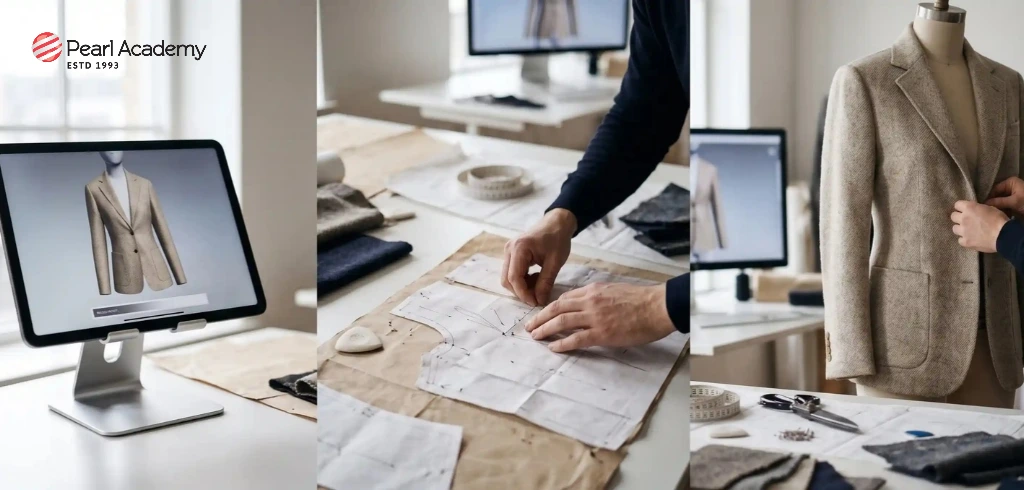
Generative AI is transforming garment production from a linear process of trend analysis, sketching, sampling, revisions, and content creation to a more flexible, iterative workflow. Instead of replacing designers or technical teams, GenAI can assist them in exploring new ideas, comparing choices, and refining designs before going to physical samples or production. This allows teams to make more confident decisions while minimizing wasteful iterations. Prompt-to-pattern pipelines provide a structured approach to integrating GenAI into apparel development.
Become future-ready with our Fashion Programs
Know More
What is a Prompt-to-Pattern Pipeline?
In apparel development, a prompt-to-pattern pipeline is a digital workflow that uses AI to turn text descriptions or fashion sketches into sewing patterns and technical specifications. It helps streamline the design process by converting creative inputs into production-ready pattern details.
What is Generative AI in Apparel Development?
According to McKinsey’s 2026 fashion survey, more than 35% of fashion and luxury executives reported already using generative AI in functions such as image creation, copywriting, consumer search, product discovery, and online customer service.
Generative AI is changing how apparel is developed, helping fashion teams move faster from consumer insights to design concepts, visualization, and product storytelling. Its real value is supporting designers, technical developers, and merchandisers rather than replacing them. By combining AI-assisted ideation with reliable product data, 3D workflows, and human creative judgement, brands can reduce unnecessary iterations, respond faster to changing consumer demand, and create more relevant apparel collections.
The Prompt-to-Pattern Pipeline: A Step-by-Step View
Prompt-to-pattern pipelines translate early design ideas and complex design requirements into structured workflows. LLMs can break complex tasks into clear, manageable stages:
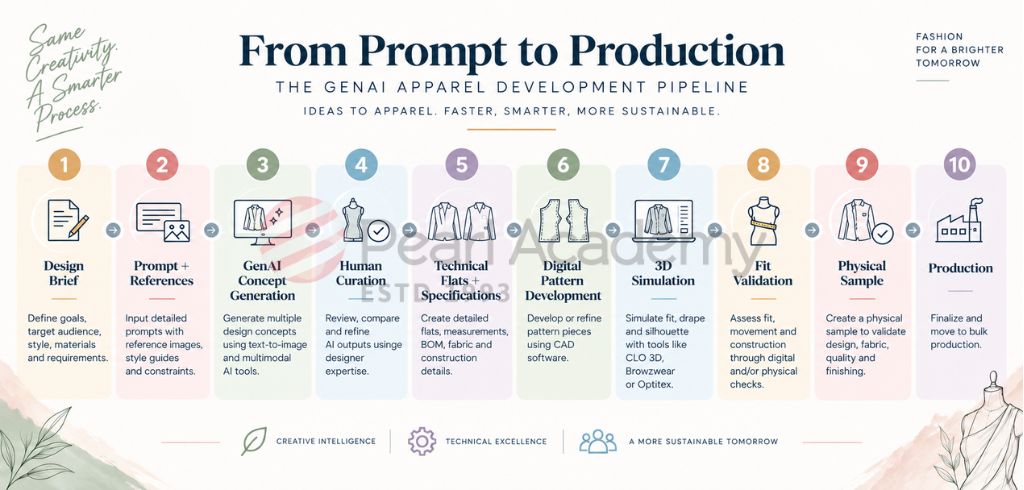
Step 1: Write a Design Brief Before Writing a Prompt
The first step in the prompt-to-pattern pipeline is to understand your requirements, needs, and expectations by creating a comprehensive design brief. Generally, directly going into writing prompts results in prompt drift, which may result in hallucinated responses and inaccurate outputs.
Step 2: Generate and Curate Concept Directions
Now that you have understood your requirements clearly, the next stage involves feeding the AI tool with data, instructions, and prompts to generate or give your concepts the right directions. Designers may often use text-to-image AI tools to generate detailed images based on prompts.
Step 3: Translate Images into Design Decisions
Once the designer has a concept in the form of AI-generated output, they can now transform these ideas into actual design decisions and concepts. AI outputs help designers plan and construct their designs. By looking at an AI-generated image, a designer can make a choice between different draping techniques, choose fabric for garments based on design style, etc.
Step 4: Create Technical Flats, Measurements and Specifications
After finalizing the concept, designers can then create technical flats or 2D mockups of the design, which include front, back, and the detailed views. Furthermore, based on client requirements, designers can determine the size chart, measurement scope, Bill of Materials (BOM), hardware, etc.
Step 5: Move From Concept to Pattern and 3D Simulation
The next step in the prompt-to-pattern pipeline is to create a 3D realistic simulation of the design concepts. Designers use digital pattern-making software such as (CLO 3D, Browzwear, or Optitex) to process the 2D mockup and transform it into a wearable virtual design to assess the fit, silhouette, and drape.
Step 6: Validate Through Sampling and Production Review
The digitally produced design is then created as a sample before going for mass production. Sampling helps designers to understand how the design will look in real-world, quality of the final product, and overall feedback on the design.
Where GenAI Can Add Value in Apparel Development
GenAI is changing design practices and how firms plan their production pipelines. By fast-tracking the research, ideation, and conceptualization process, GenAI allows fashion designers and firms to save money and time by deploying automated detailed outputs.
Faster Concept Exploration
Traditionally, designers spend hours or even days conceptualizing a design idea. They spend time brainstorming with mood boards and spend significant time with fashion resources to get design inspiration. GenAI helps designers create hundreds of design images and drafts using text-to-image prompts.
Print, Textile and Surface-Pattern Ideation
Using GenAI models, designers can create variations of designs in unique color palettes, design prints, and textile ideas. Designers can instantly get ideas for new color schemes, and unique design outputs.
Improved Cross-Functional Communication
By digitally, visualizing concepts across production lines helps different functions of the pipeline clearly understand the requirements. Accurate AI-generated pictures reduce misconceptions, which saves money in the long run.
Virtual Sampling and Earlier Design Decisions
Physical prototypes are both costly and time-consuming to create. GenAI can apply photorealistic digital designs to virtual avatars. This allows teams to digitally approve styles, fits, and materials, significantly reducing the number of physical sample rounds.
Product Storytelling and Range Planning
GenAI may incorporate fresh clothing designs into high-quality lifestyle images or simulated retail lookbooks. This allows merchants to see how a collection works together on the sales floor and streamlines B2B selling to retail buyers before production begins.
Why Human Expertise Remains Necessary
While GenAI can help designers develop detailed concepts while saving time and reducing costs, human involvement is still essential in apparel development. Fashion design goes beyond conceptualization and requires hands-on expertise, creativity, and craftsmanship, including sewing, innovative draping, and garment construction. Some aspects still cannot be handled reliably by GenAI alone. These include:
| GenAI output | Why human expertise remains necessary |
| Fashion image | May not show a physically constructible garment |
| Sewing pattern | Requires precise geometry, fit, and grading validation |
| Fabric representation | May not accurately reflect weight, drape, stretch or finish |
| Trend recommendation | Requires market, customer and brand-context judgement |
| Print design | Must be checked for originality, repeat logic and production requirements |
| Technical pack | Needs accurate measurements, construction instructions and supplier-ready details |
| Size and fit advice | Must account for target body data, testing and wearer comfort |
What Fashion Designers Must Learn Next
In today’s fast-changing fashion industry, designers must learn digital and data skills along with traditional craftsmanship. Fashion houses now are integrating GenAI and digital tools to create design concepts and simulate potential collections. Therefore, fashion designers must learn the following skills:
1. Prompting as Art Direction
Designers must learn to guide AI tools with precise words, information, data sets, and style guides. Designers must learn to use AI tools as creative assistants that require precise directions to produce actionable outputs.
2. Fashion CAD and Technical Flats
Designers must learn to create clean and accurate flat 2D sketches using computer software and design programs. Furthermore, Designers should learn to draft clear technical packages that manufacturers can easily read and build.
3. Pattern Making and Garment Construction
Designers should learn to develop unique print patterns, fabrics, color palettes, stretches, and know how their designs connect to the human body.
4. 3D Garment Design and Digital Sampling
Instead of creating physical samples, designers can save time and money by using design tools such as CLO 3D or Browzwear and creating 3D simulations.
5. Fabric, Material and Sustainability Literacy
Designers should learn about the lifecycle of natural, recycled, and synthetic fibers. Furthermore, having a good knowledge of fabric and design materials helps designers to innovate and explore new ideas.
6. Data, Consumer Insight and Merchandising Awareness
Designers need to know who buys their designs, what the consumers are looking for, and what the market demand is. Market awareness helps designers plan their collections, pricing, and inventory.
7. AI Ethics, Copyright and Brand Integrity
With the role of GenAI growing in the design and conceptualization process, designers must know the limits and adverse effects of AI use in design. Designers must ensure that their brand is honest, original, and respectful of other creators.

Student Guidance Center: Our Counselors are Just a Click Away.
Conclusion
Designers are now using GenAI tools and design software to ideate, conceptualize, and produce unique design elements. These tools have evolved as assistant tools for fashion designers, allowing them to explore new concepts, silhouettes, and patterns. FUTURE designers must learn modern technical, digital, data, and marketing skills along with craftsmanship and design skills to identify market patterns and innovate new ideas.