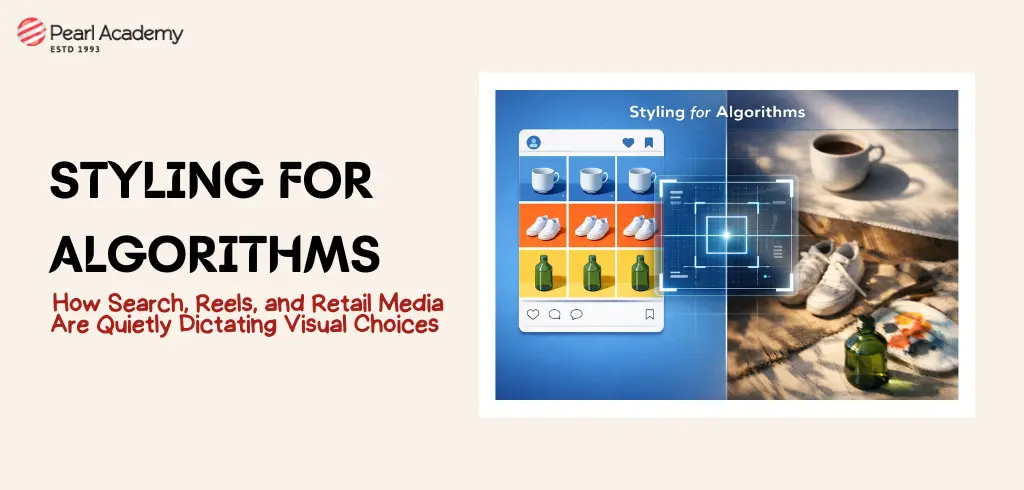
Take a moment to observe your current retail media feed. You will likely notice a peculiar visual rhythm. The lighting is identical. The product placement is mathematically centered. The colours seem to vibrate at the same frequency. This is not a collective accident of style. It is the result of Machine Vision Optimization. In 2026, we are no longer just designing for the human retina. We are styling for the Visual Spider. This is the AI model that decides if your content is eligible for the infinite scroll.
As a scholar of aesthetic evolution, I find this shift from "human centric" to "processor centric" design to be the most significant turning point in modern branding. We have moved beyond the age of creative expression and into the era of computational compliance. When a brand chooses a typeface or a color palette today, they are not just asking if it looks good. They are asking if the algorithm can read it in less than a millisecond.
Become future-ready with our Fashion Programs
Know More
Why has our visual world become so predictable? The answer lies in how search and social algorithms categorize information. The machine does not see beauty. It sees data points.
- Feature Extraction: Algorithms scan an image for specific vectors like sharp edges and high contrast text. If a design is too subtle or artistic, the machine fails to categorize it. This leads to the product being buried in a digital graveyard of unranked content.
- The Safety Markup: Retail media platforms now quietly penalize noisy backgrounds or off-centre compositions. These elements confuse the automated Shop the Look tags that drive modern conversion.
- Compression Aesthetics: We are choosing textures that survive the heavy compression of 5G reels. Soft gradients are out while bold, flat blocks of color are in. This ensures that the image remains crisp even when bandwidth fluctuates.
The result is a culture of Visual Flattening. We are trading the unique soul of a brand for the guarantee of algorithmic reach.
Consider the recent shift in premium streetwear. While mass market brands are leaning into Algorithm Core, high end houses are doing the opposite. They are using low resolution photography, intentional motion blur, and shadow heavy compositions. This is a deliberate attempt to create Visual Friction.
By making an image hard to read for the audience, they make it fascinating for the human eye. These brands are betting that the dopamine hit of seeing something real and messy will outweigh the penalty of a lower algorithmic score. They are using curated imperfection as a signal of authenticity in a world of polished automation.
CAUTION AHEAD: SPORADIC CHANGES IN ALGORITHM
Staying relevant to trends is no longer optional for brands — it is a survival condition. But the pressure to keep pace has created a new problem: branding and communication teams are increasingly spending their energy reacting to the feed rather than building something that lasts.
The speed of this is worth noting. Trend cycles on social media, which once turned over every six months or so, are now moving significantly faster — some micro-trends on TikTok and Instagram peak and burn out within weeks. What was once a content calendar challenge has become a near-constant operational demand. The result is that communication teams find themselves in a permanent state of catch-up, with real brand-building work — positioning, narrative, identity — consistently deprioritised in favour of whatever the algorithm is rewarding this week.
And the audience is starting to push back. In 2025, over half of Gen Z — 52% — attempted to quit social media according to YourTango, a striking figure for a generation that grew up entirely online. A 2025 Deloitte survey found that nearly a third of Gen Z respondents had deleted a social media app in the previous twelve months CNBC, while global daily time spent on social platforms declined by almost 10% between 2022 and the end of 2024, with the sharpest drops among teens and young adults. CNBC This is not a fringe phenomenon. It reflects a genuine and growing fatigue with the volume, pace, and artificiality of algorithmically-driven content.
Not every member of your audience is living inside the trend cycle, and designing your entire communication strategy around those, means actively neglecting those who are not. Content cycles are moving faster than ever, with social media trends often little more than fleeting moments Sprout Social — and experts are increasingly advising brands to post less frequently and more purposefully rather than chasing volume.
The brands navigating this well by sharing one quality: authenticity. Winning brands are intentionally moving away from overly polished content. Imperfections and natural pacing signal authenticity, even when AI is working behind the scenes. Hootsuite Authenticity is not a tone of voice — it is the coherence between what a brand says and what it does, sustained across every channel and every touchpoint, online and off.

Student Guidance Center: Our Counselors are Just a Click Away.
As we look toward the remainder of 2026, the competitive advantage will shift. The early part of the decade was about fitting into the algorithm. The next phase will be about standing out from it. To survive, brands must develop a dual visual language.
You need the Machine-Readable content to drive the initial volume, but you need the Human Resonant content to drive the retention. If you only talk to the engine, the people will eventually stop listening. Unfortunately, the fast fashion brands, who have already adapted machine friendly creatives, are suffering now. The revenue of ZARA in India has been observing a flatline since 2024(According to ‘Apparel Resources’). The Luxury brands like Dior, Prada & others have seen the same or lower revenue curve in last 3 years. The future belongs to those who can speak to the machine without losing their human voice.
References
- Matrix Content Team. (2025, March 31). The algorithmic aesthetic: How social media is designing human taste. Matrix Marketing Group. https://matrixmarketinggroup.com/algorithmic-aesthetic-social-media-designing/
- Roszko-Wójtowicz, E., Sharma, G. D., Dańska-Borsiak, B., & Grzelak, M. (2023). Customer engagement with digitalized interactive platforms in retailing. Journal of Business Research, 164, 114001.
- Vargo, S. L., & Lusch, R. F. (2016/Updated 2023). Institutions and axioms: An extension of service-dominant logic. Journal of the Academy of Marketing Science. https://doi.org/10.1007/s11747-015-0456-3