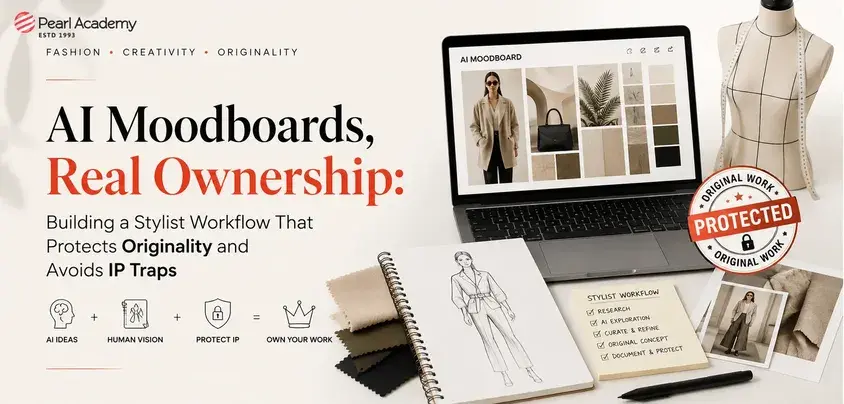
Moodboards are visual planning tools used by fashion stylists, designers, and other creative professionals to organize design ideas, inspiration, concepts, timelines, colour palettes, and other essential elements of a project. Traditionally, stylists have been creating moodboards manually conducting extensive research, costly reference sourcing, and lengthy brainstorming sessions. Artificial intelligence is now changing this by offering dynamic moodboards, created within seconds using prompts and reference images. While helpful to fashion professionals, this practice has also raised several challenges in terms of IP rights and ownership of the design. In a time when IP laws around AI generated moodboards and works remain vague, future stylists must learn to adapt to the changing industry trends and use AI as a creative assistant.
Become future-ready with our Fashion Programs
Know More
Moodboards have long been used by stylists, graphic designers, and managers to ideate and brainstorm new concepts and projects. Traditionally, moodboards are created manually using several references and ideas. AI moodboards on the other hand, are digitally created collections of cohesive collages of colours, textures, typography, and concepts for creative projects. Stylists can use text prompts or reference images to process AI technology to instantly produce a collection of images, colours, and styles, creating detailed moodboards that define a potential collection or design idea.
In a fast-moving industry such as fashion, stylists are often under pressure with growing demands for new ideas, design concepts, and innovations. Moodboards have helped designers to lay out their imaginations and brainstorm new concepts. However, manually crafting a moodboard takes significant manual effort and time. AI moodboards come in handy for designers to save time and money in the ideation process, help clients visualize abstract concepts more clearly, and allow trend-led styling ideas. The following are some of the key reasons why AI moodboards are gaining popularity among fashion stylists:
1. Reduce time and cost: Traditionally, stylists and designers alike have used Pinterest, Internet, Fashion Magazines, Editorials, Runway Archives, and other sources to create references. On the other hand, AI can generate visual references and moodboard concepts from prompts, reducing time and cost.
2. Help clients visualize rough ideas: Many initial style ideas are often rough and abstract, which makes them difficult to understand. AI generated moodboards create elaborate and detailed briefs for clients.
3. Support trend-led styling: Fashion trends today keep on changing, making it challenging to stay within a trend or moment. Some AI-powered trend forecasting platforms combine publicly available fashion data, runway imagery, retail catalogues, and trend reports to suggest concepts aligned with emerging fashion directions.
4. Make for easier collaboration: Digitally created dynamic moodboards allow stylists and designers to seamlessly share ideas across firms and collaborate with different teams.
5. Easily accessible: AI moodboards are easily accessible to stylists and designers, as it is easier to gather references and ideas at one place in a concise manner.
While easily accessible, insightful, and easy to process, AI moodboards also pose significant challenges in terms of property rights and ownership. Copyright regulations around AI generated moodboards remains uncertain across the globe. As per rulings across different intellectual property rights cases in countries such as India, US, and European Union, most of the times, authorities have refrained from recognizing purely AI-generated moodboards as original works, and therefore, authorship strictly requires human creation. Therefore, the AI cannot own the idea, and you cannot claim exclusive copyright over an image purely generated by machine algorithms.
AI styling workflows pose several IP traps that raise concerns such as plagiarism, and intellectual property rights. The following are some of the common IP traps in AI moodboards:
1. Output ownership concerns: Indian, US, and European Union countries do not recognize AI generated workflows as legitimate independent works. Therefore, a significant human interference is required to claim property rights. If a moodboard ideation is completely generated through AI, the work may be copied by other stylists as it may not qualify for copyright protection, making exclusive ownership difficult to establish.
2. Accidental copyright infringement: Often while researching stylists may use prompts such as “in the style of [Famous Designer]” or upload an image of reference to feed inspiration to the AI model, the work produced by AI may result in something that is very similar to existing copyrighted works.
3. Trademark violations: If AI tools are provided for references, they may replicate brand logos or specific signatures. This may result in accidental trademark infringement and violations resulting in serious IP issues.
4. Proprietary data leaks: Uploading unreleased designs and classified moodboards to AI tools, poses a serious privacy threat as most machine learning tools can use this data to train their models.
How to Avoid IP Traps in AI Styling Workflows
In the following table, we have explained how stylists can avoid IP Traps in AI styling workflows:
| IP Traps | Issue | Solution |
| Output ownership concerns | AI generated moodboards are not recognized as original works by several authorities | - Ensure meaningful human interference.
- Save all original documents such as sketches, ideas, colour schemes, and editing layers.
|
| Accidental copyright infringement | Feeding information to AI tools can lead to similarity or similar results as original the original work | Avoid "in-the-style-of" prompting. Use generic descriptors and conduct reverse-image searches to ensure your moodboard is unique |
| Trademark violations | AI models can generate recognizable brand logos and signatures if prompted incorrectly | Apply negative prompts to block recognizable branding (e.g., "exclude logos, specific watermarks"). |
| Proprietary data leaks | AI can use the uploaded data to train their models, raising privacy concerns | Use enterprise-tier tools that guarantee data privacy and offer zero-training policies |
Balancing the stylist integrity and AI use for creation of detailed, informational, and elaborate moodboards can be a challenging task. However, with a careful workflow, stylists can use AI moodboards for high-paced, low cost, and diverse ideation.
1. The ethical prompting & sourcing phase: To ensure ethical use of AI tools to create unique boards, you can apply the following:
- Use your licensed assets: For initial style seeds to feed AI, upload your own reference photos, past client shoots, or fabric swatches.
- Ethical generators: Use licensed software and AI tools to process data to ensure the resulting images are commercially safe.
- Control variables: Explicitly define the mood, color palette, and fabric rather than using generic terms.
2. Iteration and editing: Generate multiple variations before selecting and refining the strongest direction.
- Maintain color fidelity: Ensure that the AI uses a consistent hex code or color reference throughout the board.
- Maintain silhouette control: Make sure the AI appropriately reflects the drape, folds, and cut of a garment.
- Manual refinement: Never export raw AI output directly. Manual editing can be used to remove AI artifacts, change accessories, and fix visual inconsistencies.
3. Collaborative organization: Combine your generated pictures and manual references on a single, unified canvas.
- Organize boards by project stage: Make separate sections for lighting, supplies, and narrative.
- Label clearly: Before sharing with your team or clients, include concise labels, color palettes, and explicit "do and avoid" instructions.
- Use compliant and collaborative tools: Use business-aligned whiteboarding tools to get customer feedback and get approval without risking your project data.

Student Guidance Center: Our Counselors are Just a Click Away.
Artificial intelligence is reshaping creative workflows across the fashion industry. However, to maintain creative integrity and fair use of original works, designers and stylists alike must be aware of intellectual property rights and fair use of AI in creative works. As explained, many governments do not recognize a fully AI-generated project as an original, work; stylists must learn to work with the technology and protect original works. According to McKinsey estimates, generative AI could add $150 billion to $275 billion to the apparel, fashion, and luxury sectors’ operating profits by 2026 to 2028, signaling towards a fast-changing industry. Future stylists must not only be creative with their ideas, but also ensure their ideas are sourced from creative thinking and instead of using AI for creating moodboards, the tools should be used as helpful assistants to help save time and costs.
References