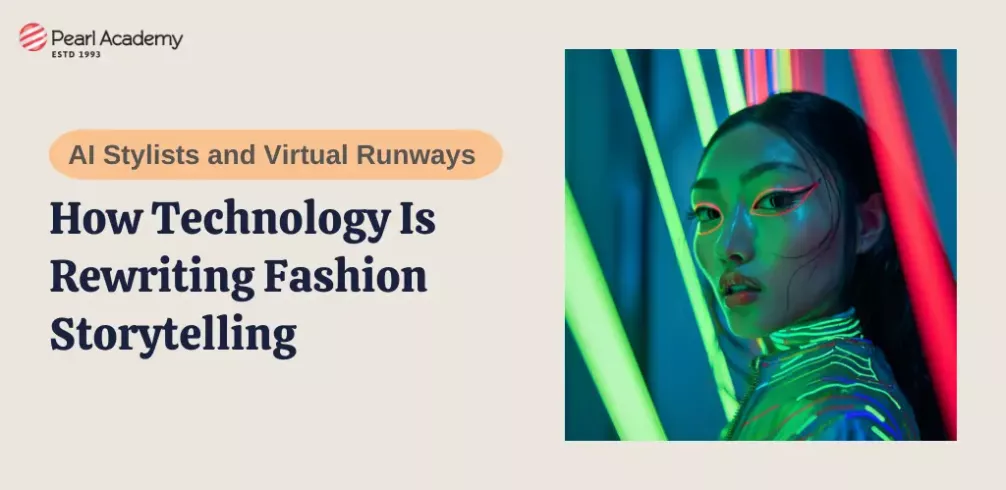
Fashion has always been about storytelling.
For years, that story unfolded on physical runways: the rustle of silk, the faint aroma of perfume, the collective pause when a model stepped onto the catwalk. These were sensory moments, and they shaped how fashion was experienced, remembered, and desired.
But somewhere along the way and very clearly as we move into 2026 the front row shifted.
Today, fashion stories unfold on virtual runways, inside AI-generated worlds, and through digital styling tools that exist far beyond the limits of physical space. Technology is not replacing creativity. It is simply changing where fashion narratives live, and how they reach their audiences.
Become future-ready with our Fashion Programs
Know More
The move towards digital fashion is not about placing garments on a screen. It is about rethinking how fashion is imagined in the first place.
Not long ago, a fashion shoot meant weeks of planning, accompanied by scouting locations, sourcing talent, and coordinating teams. Increasingly, stylists and image-makers are now building entire worlds using AI tools like Midjourney and Stable Diffusion. These environments are often impossible in real life, yet emotionally convincing and visually impactful on screen.
In fashion classrooms today, students discuss AI-generated editorials alongside traditional mood boards, sometimes within the same brief. This overlap is no longer theoretical; it is already shaping how the next generation of stylists think and work.
At the same time, AI virtual stylists are becoming part of the consumer journey. By analysing body data, preferences, and behaviour, these systems create styling recommendations that feel highly personal sometimes more precise than human-led suggestions.
In India, luxury brands are actively experimenting with augmented reality and virtual try-ons. A bride based in London can now visualise herself wearing a Sabyasachi lehenga crafted in Kolkata, experiencing couture through a digital lens. This is not a gimmick. It reflects a quiet but significant shift towards access, reach, and global storytelling.
As fashion moves deeper into digital spaces, a new visual language is emerging one shaped not only by designers and editors, but also by algorithms and data.
For instance, virtual models such as Shudu (https://www.instagram.com/shudu.gram) and Lil Miquela (https://www.instagram.com/lilmiquela) are no longer novelties. They are consistent, adaptable, and endlessly scalable raising important questions about representation, identity, and authorship in fashion imagery.
Virtual runways have redefined what a fashion show can be. Events like Metaverse Fashion Week demonstrate that a show can be immersive, interactive, and viewer-controlled, where audiences explore collections in 360 degrees and manipulate light, space, and texture.
Hyper-personalisation means fashion storytelling is no longer one narrative broadcast to millions. It is millions of micro-stories, shaped by individual data, preferences, and digital behaviour.
For fashion stylists and communicators, this moment demands fluency in aesthetics and algorithms.
Ignoring either is no longer an option.
These shifts have direct implications for how fashion is taught.
The role of the stylist, journalist, or fashion communicator is no longer limited to curation and critique. Increasingly, creatives are expected to direct technology, question its outputs, and make ethical decisions about what is represented and what is left out.
Fashion education must therefore move beyond traditional skill sets and actively address:
- Digital literacy and AI awareness
- Ethical fashion communication
- Bias, representation, and inclusivity in virtual spaces
- Technology-enabled storytelling and image-making
Students need to learn how to work with intelligent tools, not passively accept them. This includes developing what might be called algorithmic empathy: the ability to recognise that technology reflects human values, assumptions, and limitations.
Despite the rise of AI stylists and virtual fashion shows, the core of fashion remains human.
Technology has simply become a more powerful needle and thread. The responsibility lies in ensuring that craftsmanship, heritage, cultural context, and social impact do not disappear behind polished pixels and perfect simulations.
Fashion today sits somewhere between creativity, technology, and culture and that space keeps shifting. What matters is not choosing between the digital and the physical, but learning how to hold both together with intention.
The future of fashion storytelling is not only about what we wear. It is also about how we imagine ourselves in worlds that are still being built.

Student Guidance Center: Our Counselors are Just a Click Away.
For those considering a career in fashion styling, fashion communication, or creative direction, understanding AI, virtual fashion, and digital storytelling is no longer optional.
The fashion industry today demands professionals who are visually intelligent, culturally sensitive, and technologically aware. Courses that reflect this reality do more than teach trends, they prepare students for the industry as it exists now, and as it continues to evolve.
References
- Park, H., & Lim, R. E. (2023). Fashion and the metaverse: Clarifying the domain and establishing a research agenda. Journal of Retailing and Consumer Services, 74, 103413.
- Kim, S. J. (2023). Virtual fashion experiences in virtual reality fashion show spaces. Frontiers in Psychology, 14, 1276856.