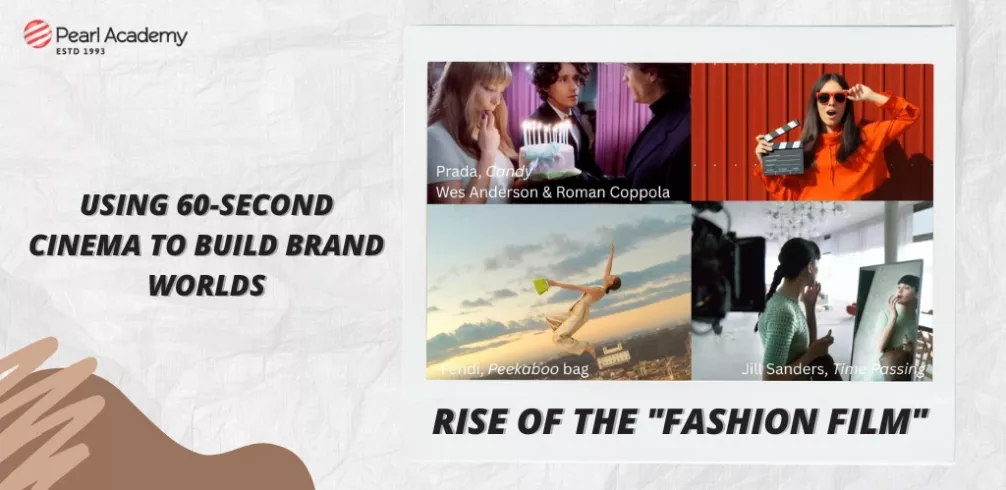
Using 60-Second Cinema to Build a Brand World is leading to a rise in popularity of Fashion Films.
The arrival of the story is fast replacing direct advertising by brands, and marketers are arrogating the value of the narrative, so far, the preserve of the creative community. With all algorithms pointing to video and cinema, high-fashion brands are approaching auteurs like American film directors Wes Anderson, Roman Coppola and European filmmakers such as Luca Guadagnino and Wim Wenders, all of whom are known for their experimental, lush and complex cinematic imagery. (By Madhumita Ghosh)
When a 60-second spot for Chanel or Gucci ditches the traditional product shot for a surrealist sequence of a desert hallucination or a neon-soaked car chase, we are witnessing more than just a high-budget commercial. We are seeing the crystallization of the fashion film, a genre that thrives precisely because it refuses to sell. In this compressed cinematic space, the garment is often secondary to the atmosphere it inhabits.
This raises a provocative tension, how can a medium defined by its brevity and commercial intent function as a legitimate site of avant-garde narrative. Increasingly, brands are trading the hard sell for something far more seductive. A 60-second cinema that builds entire worlds rather than simply showcasing products.
Become future-ready with our Fashion Programs
Know More
Historically, fashion on screen was purely functional, a digital extension of the catwalk. However, the migration of the medium to platforms like Instagram and TikTok has forced a radical evolution in form. Unlike the lifestyle advertising of the twentieth century, which focused on aspirational realism, the contemporary fashion film leans into the hyper-stylized and the abstract.
As Nick Knight and the SHOW studio collective demonstrated early on, the fashion film is not a televised catalogue but a new medium for the digital age that prioritizes the visceral over the descriptive. This shift represents what some scholars call a post-advertising state, where the brand functions more like a film studio or a patron of the arts than a traditional manufacturer.
In 60 seconds, there is no time for a three-act structure. Instead, fashion films utilize what’s called aesthetic saturation to build entire brand worlds. By leaning on the semiotics of cinema, using lighting, soundscapes, and non-linear editing, brands like Miu Miu, through their Women’s Tales series. The series is the longest running short tales directed by distinctive female filmmakers, and every tale in the series is a world inhabited by women’s idiosyncratic imaginations transcending the designer’s seasonal collection.
Marketa Uhlirova, a professor of Fashion, Cinema and Visual Studies, University of Arts, London, (2013) notes that fashion film operates at the intersection of the attractions of early cinema and the high-concept art film, focusing on the power of the image to provoke an effective response rather than a logical sequence of events. The 60-second constraint acts as a creative catalyst, necessitating a visual shorthand where a specific shade of Valentino Pink (PP Pink) on a few seconds of film stock communicates heritage more effectively than any dialogue could.
The dominance of the one-minute format is a direct response to the fragmented attention of the digital spectator. Yet, there is a paradox here, as the duration shrinks, the production value skyrockets. We are seeing a cinematization of the social feed. Brands are inviting directors such as Luca Guadagnino for Fendi, Loewe, Armani, and Ferragamo; handing out key projects including I Dreamt of Loewe (2023); a Fendi Peekaboo bag film with actress Adwoa Aboah; a Valentino short with Julianne Moore, and Salvatore Ferragamo SS21, allowing free reign of their creative imagination.
So, while avant-garde American directors like Wes Anderson and Roman Coppola teamed up for Prada Candy, Wim Wenders for Jill Sanders in Paused trilogy, brands are leveraging cinematic capital to combat scroll-blindness. This creates a fascinating experimental cinema hybridity where the fashion film acts as a gateway drug to the brand’s universe. As documented in the Journal of Fashion Marketing and Management, the efficacy of these films lies in their ability to generate brand resonance through storytelling that feels authored rather than manufactured (Bhardwaj & Fairhurst, 2010). The film becomes a collectible digital artifact, a piece of micro-cinema that users share not because they want the clothes, but because they want to inhabit the mood.

Student Guidance Center: Our Counselors are Just a Click Away.
As we look toward the future of fashion communication, the 60-second film remains the gold standard for narrative compression. However, as AI-generated imagery and interactive media begin to bleed into the genre, we must ask, at what point does the brand world become so detached from the physical garment that the fashion film ceases to be about fashion at all?
The challenge for future scholarship lies in decoding these fleeting spectacles not merely as marketing tools, but as significant contributions to the contemporary visual canon. We are no longer just consumers of products; we are residents of the digital atmospheres these films curate.
References
- Bhardwaj, V., & Fairhurst, A. (2010). Fast fashion: Response to changes in the fashion industry. Journal of Fashion Marketing and Management: An International Journal, 14(1), 165–173.
- Uhlirova, M. (2013). 100 Years of the Fashion Film: Frameworks and Histories. Fashion Theory, 17(2), 137–157.
- Photo Credits: Individual photographs are courtesy Fendi, Prada, Jill Sanders.