By Meha Jayaswal, Associate Dean, Fashion Communication and Fashion Styling
Open your screen time report and your coffee table will probably tell two different stories.
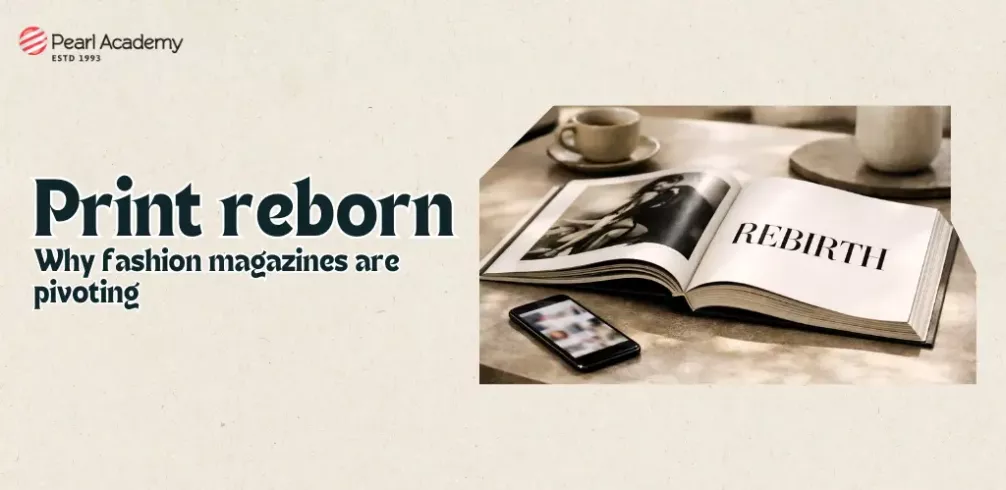
Your phone says you live online. Your coffee table, with a thick January issue of a fashion magazine next to a scented candle, quietly disagrees.
Why are readers in 2025 - 2026 paying extra for something heavy, glossy and slow to read? It’s a myth that print was supposed to die. Print did not die, it slowed. It just stopped being the fastest and cheapest medium for masses. Instead it has become a premium, curated and collectible for the Gen-Z that demands tangible, collectible print culture.
To simply claim, after decades of watching this industry from Illustrated Weekly, Femina, Vogue, Harper’s Bazaar to Dirty Magazine, Robb Report : fashion magazines are not “coming back” to the old monthly model. They are being reborn as rare, premium objects that work together with digital, not against it.
Become future-ready with our Fashion Programs
Know More
After years of chasing clicks, many readers are tired. They still love fashion, but they want a break from the constant feed. Recent reporting shows publishers repositioning print magazines for “high end” readers who treat them more like luxury goods than disposable newsstand buys.
You see it in the price and in the feel. Thicker paper. Stronger binding. Covers that look like posters. These magazines are meant to be kept, not skimmed on the way to work.
Gen Z, interestingly, is part of this shift. Coverage of the i-D relaunch in 2025 notes that young readers want something “tangible and collectible”, in the same way they have rediscovered vinyl and film cameras.
The clearest sign of this rebirth is frequency. In the United States, Vogue will move to eight print issues a year from 2026, each one thicker, built around big cultural moments like fashion month or the Met Gala, rather than a routine monthly slot.
Fewer issues do not mean less ambition. It means each issue has to justify its place on the table. Think of it as a season of a prestige series, not another episode of a daily soap. The print object sets the tone and visual language for the brand. Digital carries the fast news, behind the scenes clips, street style, live events and community.
In many cases, the magazine has become a bridge between worlds. A collector’s item that points you to a livestream, a podcast or a pop-up event, while still offering something digital cannot: the calm, slow pleasure of turning a page.

Student Guidance Center: Our Counselors are Just a Click Away.
If you are a reader, this pivot invites you to slow down. Pick one or two titles that genuinely enrich you and treat them as you would a good book.
If you are a fashion communication student, notice the craft. How does the same story appear as a cover line, a long feature, a short video and an Instagram post, while still feeling like one coherent voice?
If you work with brands, understand that a magazine in 2026 is not just marketing. It is part archive, part gallery, part manifesto. Used well, it can say what an algorithm friendly post cannot.
Print is not returning to its old life. It is evolving into something rarer and more deliberate. In a noisy, hyperactive media world, that is exactly why it matters.
References
- Mac Donnell, C. (2025, March 25). “Tangible and collectible”: i-D back on shelves as Gen Z revives fashion magazines. The Guardian. (The Guardian)
- Milnes, H. (2025, October 3). The future of fashion magazines: Fewer, more premium issues. Vogue. (Vogue)
- Mull, A. (2024, October 24). The print magazine revival of 2024. Bloomberg Businessweek. (Bloomberg.com)