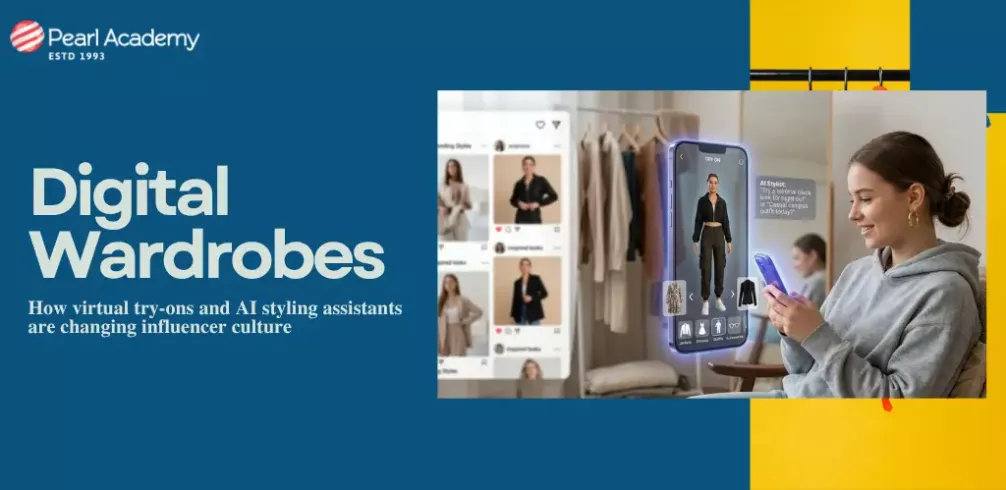
At a campus workshop last month, a student handed me her phone.
On one screen, an app showed her body as a 3D avatar, cycling through outfits from brands she had never physically tried. On another, an AI chat window suggested “five looks for a Bangalore gig, under ₹3,000.”
No friends in sight. Yet she had a full styling team in her pocket.
That moment felt like a glimpse into the future. Our wardrobes are quietly turning digital-first, and this shift is rewriting influencer culture. Because in a pool of crop tops and cargos, people are beginning to crave something deeper than trends: individuality.
Become future-ready with our Fashion Programs
Know More
Influencers once held power because followers had to imagine their outfits on their own bodies. You watched someone tall, slim, and camera-ready wear a corset top and hoped it might look similar on you. That distance was part of influencer culture’s charm i.e. aspiration mixed with fantasy.
But virtual try-ons collapse that distance.
AR lenses and in-app fitting rooms now let you see sneakers, sunglasses, lipstick, and even full outfits on your own body in real time. According to BrandXR (2025), hundreds of millions of Snapchat users engage with AR lenses daily, often to discover and virtually try on products.
So, the influencer’s post is no longer the finish line. It becomes the starting point. The main canvas is no longer their body, but yours.
Virtual try-ons are impressive. They are quick, frictionless, and almost addictive. They can replace the influencer’s body with yours in seconds.
But there is a missing ingredient: personal style.
A virtual try-on can show you how a dress falls on your proportions, but it cannot tell you whether it feels like you. It cannot understand your relationship with clothing, your comfort zones, your insecurities, or your nostalgia. It cannot recognize that you love maximal jewellery but dislike loud prints, or that you want to dress bold but still look soft.
And this is where the contradiction lies. A virtual try-on can mirror your body, but it may still not feel authentic because it does not consider your personal style. Trying an outfit an influencer suggested through virtual try-ons on your body may still not satiate your style sensibility because it was never yours to start with. It was borrowed taste, borrowed aesthetic, borrowed identity.
Virtual try-ons can personalize the body, but they cannot personalize the self.
Alongside AR try-ons, AI styling assistants are stepping into decisions that once belonged to creators. Vogue Business reports that Gen Z is already using ChatGPT-like tools to build capsule wardrobes, plan date-night outfits, and refine their personal aesthetic, often turning these conversations into TikTok content (Francombe, 2025).
Influencers are increasingly co-starring with an algorithm:
- “My AI stylist planned my office looks for the week.”
- “I asked AI to restyle my mum’s saree collection.”
- “ChatGPT told me my aesthetic is soft grunge.”
Brands are experimenting too, launching in-app bots that recommend outfits based on body data and purchase history (Toyib & Paramita, 2024). The old “DM me for links” is slowly shifting into something more futuristic: “My AI wardrobe built this for me.”
Influencer culture was built on repetition. AI disrupts it.
Influencer culture has historically thrived on repetition: the same beauty standard, the same body type, the same aspirational lifestyle. It worked because consumers had limited reference points. If the “ideal” influencer wore something, it became the blueprint.
But virtual try-ons disrupt this.
If users can see outfits on avatars that resemble them, they no longer need to rely on one “ideal” influencer body. They will actively seek creators who reflect their proportions, skin tones, styling needs, and cultural aesthetics.
This is not a minor shift. It is a cultural correction. Instead of following one aspirational creator, audiences will curate their own micro-influencer ecosystems: a midsize creator who styles for humidity, a petite creator who understands proportions, a hijabi creator who masters layering, a creator who understands Indian skin undertones.
Research supports this demand. Studies on AI fashion figures suggest audiences respond better to depictions that feel genuine and human-like (Toyib & Paramita, 2024). This becomes even more relevant in a world where the “influencer” may not even be human.
The future influencer economy will likely split into two categories:
- Mass-market AI-generated fashion figures designed for scale
- Highly specific human creators valued for authenticity and lived experience
AI influencers will dominate mainstream campaigns because they are scalable, predictable, and endlessly customizable. But the more digital fashion becomes, the more audiences will crave the human factor: context, imperfection, culture, emotion.
Influencers will not disappear, but their relevance will depend on what they can offer that AI cannot.
From influencer to stylist: context becomes the new currency
Influencers will have to evolve. Their role will become more intentional and expressive. Anybody run-of-the-mill will be overshadowed by AI, and the fashion world will see the rise of potential stylists and not just influencers.
Influencers will shift from being “test pilots” to becoming taste makers. Their value will lie in explaining why a recommendation suits a particular life, not just a trend.
AI can build capsule wardrobes efficiently. It can calculate combinations and recommend basics. But influencers and stylists can create something more powerful: concept wardrobes.
A concept wardrobe is not about minimalism. It is about meaning. It considers personality, lifestyle, mood, identity, personal colours, cultural influence, nostalgia, and emotional expression.
AI can make fashion accessible, but influencers can make it individualistic. That is the difference between wearing clothes and wearing a point of view.
There is another shift coming, and it is unavoidable: ethics.
AI makes shopping frictionless. You can try on ten outfits virtually in five minutes and add them to cart without ever stepping into a store. That makes consumption faster, easier, and more impulsive.
Fashion hauls will increasingly be questioned. If influencers want to stay relevant, they will have to embrace circular approaches: rewearing, restyling, thrifting, renting, and repeating outfits with intention.
Because if AI can generate infinite looks, the only thing that matters is what you choose to actually own and why.
Influencer culture used to be linear: creator posts, audience consumes, audience copies.
What once moved in a straight line now circles back. An influencer shares a look, followers try it on virtually, AI nudges it in new directions, and everyone feeds their version back into the stream. The outfit doesn’t end, it evolves.
The biggest shift that will take the world by storm is influencer culture becoming less about consumption and more about co-creation.

Student Guidance Center: Our Counselors are Just a Click Away.
Virtual try-ons will make styling quicker. AI assistants will make fashion advice more accessible. But the creators who will thrive are those who bring what tools cannot: human perspective.
People will now choose to be individuals. Influencers will not become irrelevant, but their role will become more powerful, more conscious, and more personal.
Because the question is no longer, “Will AI replace influencers?”
The real question is, “Can influencers bring the context and conscience the tools lack?”
That is where the future of fashion and our wardrobes will be written.
References
- BrandXR. (2025). 2025 augmented reality in retail & e-commerce research report.
- Francombe, A. (2025, May 13). Gen Z is using ChatGPT as their stylist. What does it mean for brands? Vogue Business.
- Toyib, J. S., & Paramita, W. (2024). An authentic human-like figure: The success keys of AI fashion influencer. Cogent Business & Management, 11(1), 2380019. https://doi.org/10.1080/23311975.2024.2380019
- Deloitte. (2023). Digital transformation in retail: AR and virtual try-on trends. Ellen MacArthur Foundation. (2017). A New Textiles Economy.