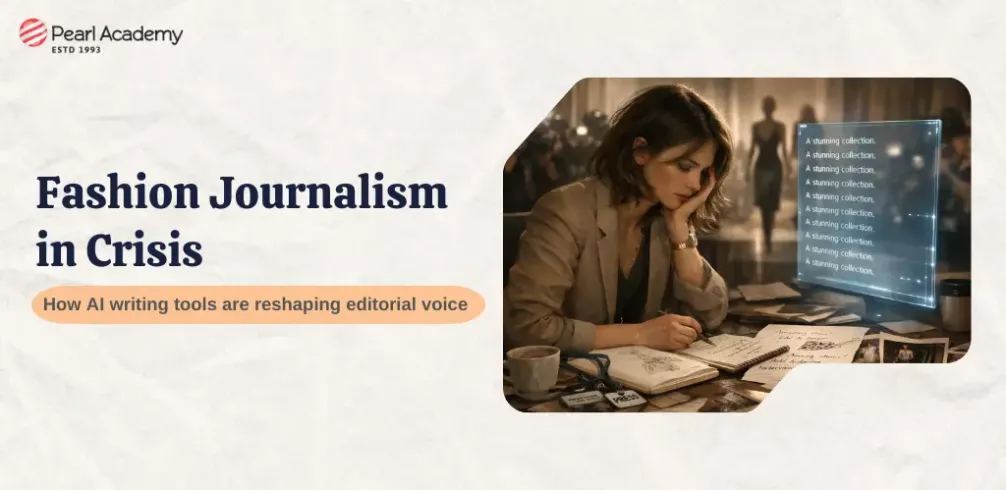
You read a review of Paris Fashion Week and feel a strange echo.
The words are polished, but you could paste them under almost any runway: “elevated basics, playful textures, confident femininity.” You reach the end and realise you have no idea who wrote it, or what they thought.
That uneasy feeling is where fashion journalism now lives. AI has walked into the newsroom, not as a headline, but as a quiet co-author.
My point is simple: AI writing tools are changing fashion journalism not by replacing writers, but by flattening editorial voice when used carelessly.
Become future-ready with our Fashion Programs
Know More
In many newsrooms, AI is now the invisible intern that never sleeps. Editors use it to tidy transcripts, draft quick blurbs, suggest headlines, or structure show notes before a human steps in. A global survey of news organisations found that most have already experimented with generative AI, often for summarising, SEO and background tasks rather than full story writing. (JournalismAI)
Fashion desks are no different. A junior critic might feed in their notes and ask the tool for “three paragraphs in a witty, conversational tone.” The time saved feels like a gift on a hectic show day.
The risk is subtle. Over time, the starting point becomes the model’s idea of “witty fashion voice,” not the critic’s.
When I started teaching, students could identify critics from a single paragraph. Some were sharp and sarcastic, some dreamy and poetic. Voice came from how they noticed a sleeve, a soundtrack, a model’s walk.
Today, I see something new. Editors talk less about “house style” and more about “house prompts.” They keep a few favourite instructions for the AI, to make everything sound on brand.
It works, in a way. The site sounds consistent. But it also starts to sound interchangeable. A 2024 study of journalists warns that generative AI can blur lines of authorship and make news work feel more mechanical if voice is not protected on purpose. (Taylor & Francis Online)
Audiences are not naïve. The Reuters Institute’s 2024 report found that people are fairly relaxed about AI helping behind the scenes, yet much more uncomfortable when it writes the news itself. (Reuters Institute)
In fashion, this tension is even stronger. Readers come for taste, judgment and a sense of mood, not just a catalogue of looks. If everything reads like a well tuned product description, trust erodes. You might still get the trend summary, but you lose the feeling of sitting next to a sharp friend at the show.
So where does this leave young fashion journalists and students?
A few practical habits help:
- Start with your own notes, emotions and questions. Let AI organise later, not decide what you felt.
- Use the tool for boring work: cutting repetition, checking structure, creating alternative headlines.
- Keep traces of your human rhythm: the oddly specific metaphor, the honest doubt, the detail only you noticed.
AI can be a useful mirror, but the gaze on the collection must still be yours.
Fashion journalism is not in crisis because machines exist. It is in crisis when we forget that criticism is a human craft: one writer, one pair of eyes, telling us why this dress, on this night, in this city, matters at all.

Student Guidance Center: Our Counselors are Just a Click Away.
References
- Cools, H., & Diakopoulos, N. (2024). Uses of generative AI in the newsroom: Mapping journalists’ perceptions of perils and possibilities. Journalism Practice. Advance online publication. https://doi.org/10.1080/17512786.2024.2394558 (Taylor & Francis Online)
- JournalismAI. (2023). Generating change: A global survey of what news organisations are doing with AI. London School of Economics and Political Science.
- Reuters Institute for the Study of Journalism. (2024). Digital news report 2024. University of Oxford.