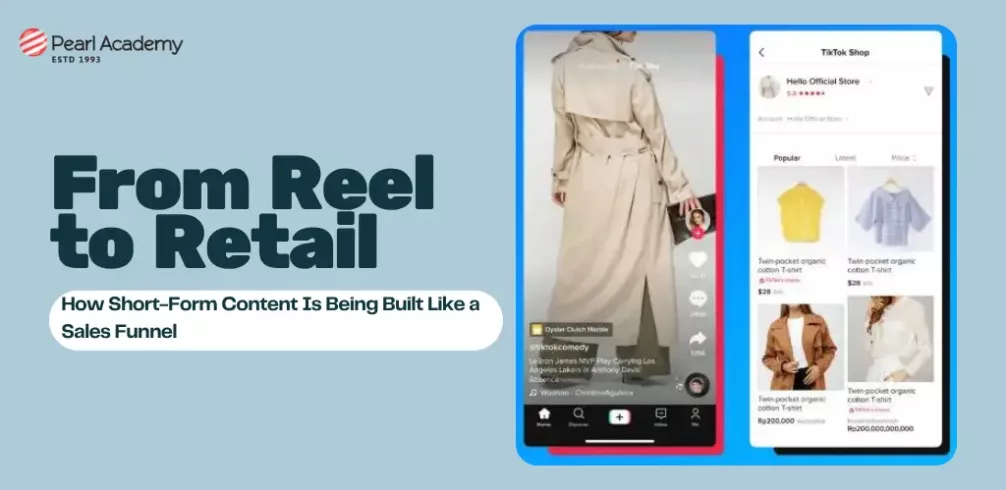
Have you found yourself purchasing a product before you even realised you were being sold to? In the fast-paced digital environment of 2026, the traditional marketing funnel has not just collapsed; it has been compressed into a fifteen-second vertical video. We have moved past the era where short-form content was merely entertainment. Today, it serves as a highly sophisticated, algorithmic sales engine that bridges the gap between digital "reels" and physical "retail" with terrifying efficiency.
As we examine this shift from an academic perspective, the consumer journey has transitioned from a linear path to a continuous loop of discovery and gratification.
Become future-ready with our Fashion Programs
Know More
In previous decades, the AIDA model (Attention, Interest, Desire, Action) took place over weeks of repeated exposure. In 2026, these four stages are executed within a single loop. This is what industry experts call the Micro Funnel.
The magic lies in the algorithmic matchmaking. Instead of a brand searching for a customer, the platform identifies the user’s "latent intent" and serves a story that feels like a serendipitous discovery. This reduces the cognitive friction of shopping. When the transition from a video to a checkout page is seamless, the "pain of paying" is culturally and psychologically minimized.
While the "Reel to Retail" transition focuses on the initial transaction, the real battleground in 2026 is Retention. High velocity sales are meaningless if they result in "one and done" customers.
The most successful brands are using short form content to build what I call Looping Loyalty. They do this by:
- Serialized Storytelling: Using recurring characters or "behind the scenes" narratives that turn a one time buyer into a series subscriber.
- Post Purchase Affirmation: Sending personalized video content that teaches the customer how to use their new purchase, thereby increasing product satisfaction and reducing return rates.
- Community Validation: Encouraging users to post their own videos, which creates a social proof loop that reinforces the original purchase decision.
Why does this work so effectively? It taps into our neurological preference for novelty and immediate reward. Each video provides a micro dose of dopamine, and the integrated "Buy" button offers a way to extend that feeling into the physical world. This system aligns closely with Daniel Kahneman’s notion of System 1 thinking, where decisions are fast, intuitive, and emotionally driven rather than deliberate.
However, there is a cautionary note for businesses. In an environment of infinite choice, retention is fragile. If the product delivered does not live up to the "high definition" promise of the reel, the brand suffers from a trust deficit that no amount of clever editing can fix. In 2026, the reel is the promise, but the retail experience is the proof.

Student Guidance Center: Our Counselors are Just a Click Away.
For businesses to thrive in this vertical economy, they must stop viewing video as an advertisement and start viewing it as a storefront. The goal is no longer just to get a "view," but to cultivate a relationship that survives the scroll. The brands that win will be those that use short form content to spark a conversation that continues long after the screen goes dark.
“Brands are no longer competing for shelf space or screen time. They are competing for an iota of attention within an infinite scroll. The challenge is no longer whether a consumer will buy, but whether they will remember why they did.”
References
- Kahneman, D. (2011). Thinking, Fast and Slow. New York: Farrar, Straus and Giroux.
- Kapferer, J. N., & Valette-Florence, P. (2024). The impact of social media influencers on brand equity and loyalty in the luxury sector. Journal of Business Research, 172, 114407. https://doi.org/10.1016/j.jbusres.2023.114407
- Wertz, J. (2025). The compression of the sales funnel: How social commerce redefined the consumer journey. Harvard Business Review Digital.
- Zhang, Y., & Li, X. (2026).Algorithmic shopping: The psychology of latent intent and impulsive purchase in vertical video platforms. Journal of Consumer Psychology, 36(2), 245–260.