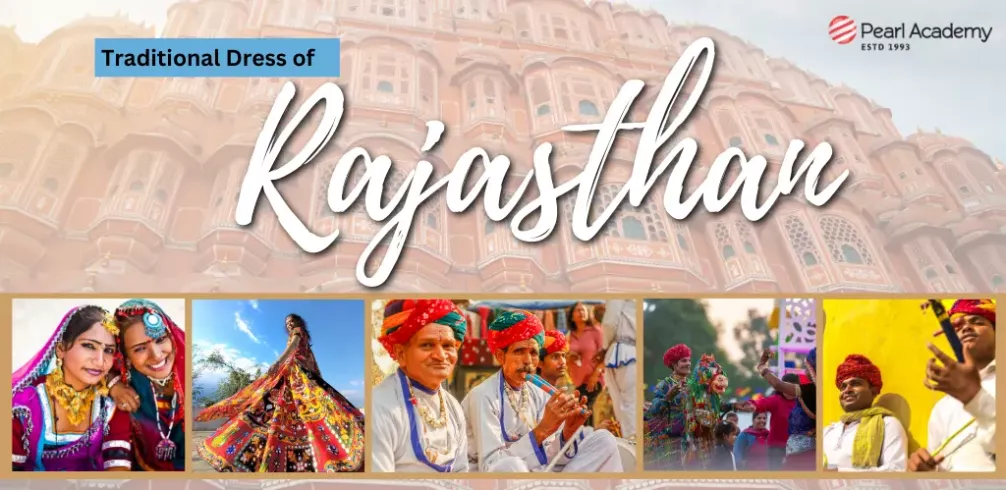
Walk through the old lanes of Jaipur or Jodhpur and you will see it instantly. Twirling ghagras, odhnis flying in the desert wind, bright pagris cutting through the sun. The traditional dress of Rajasthan is not just “costume”, it is climate strategy, social code, textile craft and fashion statement in one.
This blog will walk you through the history and meaning behind Rajasthan dress, look closely at men’s and women’s silhouettes, decode key fabrics and techniques, and finally see how these traditions are inspiring modern design careers. Along the way, you will also see how a design course like Pearl Academy’s B.Des in Textile Design can help you translate this cultural richness into contemporary spaces and experiences.
Become future-ready with our Fashion Programs
Know More
When people think of Rajasthan dress, they imagine intense colours and dramatic layers. This is not accidental. Rajasthan is a desert state with strong sun, extreme temperatures and a long history of warrior cultures and royal patronage. Clothing evolved to respond to all three.
Image Source: Pinterest
Loose, layered garments keep the body cool and allow air to circulate in harsh summers. Turbans and odhnis cover the head and face, protecting from dust and heat. At the same time, colour and pattern communicate identity. In many communities, the style and shade of pagri (turban) or odhni can once indicate region, caste, marital status or even whether there is a celebration or a mourning in the family.
Today, even when people shift to jeans and shirts for daily wear, these visual codes return strongly during festivals, weddings and cultural events. The traditional dress of Rajasthan becomes a way to reconnect with roots while still living in a modern world.
At the heart of Rajasthani traditional attire are a few recurring pieces that you will keep seeing, even as details change from district to district.
Image Source: Pinterest
For women, the classic combination is:
- Ankle length ghagra (skirt), often flared and heavily printed or embroidered
- Choli or kanchli (blouse), fitted and sometimes layered
- Odhni or chunari (dupatta), draped over head and shoulders, often in bandhani or leheriya
For men, the typical set includes:
- Dhoti or pyjama, wrapped or stitched lower garment
- Angrakha or kurta, a wrap-style or straight tunic
- Pagri or safa, the famous Rajasthani turban in vibrant bandhej or leheriya
These silhouettes may look decorative, but they are practical. Fabrics are usually cotton or light silk so that bodies can breathe. One visible growth trend in the textile industry is increasing the production of clothing made from natural fibers like cotton, silk, linen, wool, jute, and cashmere to promote sustainability. Even plastic waste is now being recycled into fabric! Bright colours stand out against the sand and add warmth to community gatherings. Jewellery, kamarbandh (waist belts) and mojari footwear complete the look for both daily life and special occasions.
If you close your eyes and picture Rajasthani traditional dress female, you probably see a ghagra swirling in circles of bandhani dots or leheriya stripes. This set is iconic for a reason.
Image Source: Pinterest
The ghagra is usually ankle length, with many kalis (panels) to create flare. It can be plain, printed, or covered in motifs using block print, mirror work or gota patti. The choli is cropped and fitted, sometimes with laced backs or side tie-ups. The odhni is the most expressive piece: it may carry auspicious red bandhej, pastel leheriya or intricate borders with gota work.
Traditionally, many women were expected to cover their head or even part of the face with the odhni as a mark of modesty and respect for elders. At the same time, the odhni acts as a shield against sun and dust in daily chores or long walks between fields and home.
In modern times, the same trio appears in bridal lehengas, fusion outfits and festival wear, with updated cuts, lighter fabrics and contemporary colours, but the essential structure remains the same.
It is useful to look at Rajasthan traditional dress male and female together, because you start to see a shared design logic.
Both men and women:
- Use light, breathable fabrics suitable for desert climate
- Layer garments to control temperature and protect skin
- Play with intense colours and pattern as visual identity
- Use textiles like bandhani, leheriya and block prints as central design elements
Image Source: Pinterest
For men, the dhoti or churidar with angrakha and pagri forms the base. The length and cut of the angrakha, as well as the style of pagri, can signal region and social status. Jewellery like ear studs, bangles, necklaces and waistbands is common, especially among Rajput and merchant communities.
For women, the ghagra choli and odhni play a similar role, but with more variation in embroidery, border work and jewellery as markers of marital status, community or occasion. The couple standing together at a wedding or festival becomes a moving display of Rajasthani textile art.
The phrase Rajasthani women dress covers a surprising range, from everyday cotton ghagras worn in villages to high fashion lehengas on bridal runways. Yet the visual vocabulary is deeply connected.
Image Source: Pinterest
In rural areas, older women may still prefer heavier cottons, strong colours like red, maroon, magenta and dark green and dense bandhani patterns. In cities, younger women might choose lighter georgette or chiffon ghagras, pastel leheriya dupattas and slimmer cholis. Bridal wear often adds rich gota patti work, zardozi borders and multiple layers of can-can for volume.
Image Source: Pinterest
The jewellery story is equally rich. Borla maang tikka, aad choker necklaces, long rani haars, bajubandh armlets and thick bangles all contribute to the distinctive Rajasthani bridal look. The result is a balance of heritage motifs with fashion-forward styling.
For design students, this evolution is a live case study in how traditional silhouettes can adapt to modern comfort, global trends and social media aesthetics without losing their core identity.
Image Source: Pinterest
Although ghagra choli dominates the popular image, Rajasthani saree style is also an important part of the traditional dress of Rajasthan, especially among certain communities and in urban settings.
Two textiles are central here:
- Bandhani sarees, created through tie and dye with thousands of tiny knots, result in dotted patterns and intricate layouts. The craft has roots in Gujarat and Rajasthan and is still considered highly auspicious for weddings and festivals.
- Leheriya sarees, dyed using a wrap resist method to create diagonal or chevron stripes that resemble waves. This technique is unique to Rajasthan, with Jaipur and Jodhpur as key centres, and is especially popular in monsoon and festive seasons.
Draping styles may vary, with some women choosing a Gujarati pallu (front drape) and others sticking to the Nivi style. The saree is often paired with heavy silver or gold jewellery and a modestly styled pallu over the head for traditional events.
When people search for Rajasthan famous dress, they often want to know which outfits are most recognisable or Instagram worthy. A few images keep repeating in tourism posters and films.
- The swirling red or maroon bandhani ghagra choli with gota work and matching odhni.
- The Jaipuri leheriya lehenga in bright stripes, often paired with heavy jewellery.
- The Rajputi poshak, a more covered ensemble that includes a long kurti, kanchli, ghagra and veil with detailed embroidery and jewellery.
- The classic male look of angrakha, dhoti and pagri, sometimes paired with an embroidered jacket and mojari shoes.
Each of these looks may appear in different colour stories depending on the occasion. For example, reds and pinks are common for brides, while saffron and yellow are popular during Teej or Gangaur. Designers today often reinterpret these famous dresses into lighter, fusion garments like crop top skirts or Indo western sets.
The broader phrase traditional clothes of Rajasthan reminds us that the state is not a single culture. It is a patchwork of Rajput, Marwari, Bishnoi, Meena, Rabari and many other communities, each with its own preferences.
Image Source: Pinterest
- In Shekhawati and Marwar, you might see bolder bandhani and mirror work.
- In Udaipur and surrounding areas, Mewar influences bring specific jewellery, colour combinations and poshaks.
- In Jaisalmer and Barmer, desert climate shapes choices in fabric weight and layering.
- Tribal communities often use more black, red and white, with distinctive silver jewellery and tattoos.
These differences are not always rigid today, but they still appear in wedding trousseaus and festival wardrobes. For a design aspirant, this diversity is a goldmine of motifs, silhouettes and stories that can inspire everything from garments to interior concepts.
Traditional Attire of Rajasthan: History, Symbolism and Change
If we zoom out again and look at the traditional attire of Rajasthan historically, a few themes stand out.
First, clothing expresses status and honour. For centuries, Rajput kings and nobles supported craftspeople who created fine textiles, embroideries and jewellery. Gota patti work, for instance, originated as a royal embroidery using real gold and silver ribbons on garments for the court and temple rituals.
Second, attire is deeply tied to life events. Bandhani dupattas, safas and odhnis often appear in weddings and festivals, with specific colours and patterns associated with auspiciousness or rites of passage.
Image Source: Pinterest
Third, change is constant. Colonial contact, urbanisation and global fashion have all affected how people dress. Today it is common to see someone in Rajasthan pair a bandhej dupatta with jeans or wear sneakers with a ghagra. Yet during cultural festivals or themed tourism events, full traditional dress returns, sometimes with even more colour than before.
Rajasthani Textiles: Bandhani, Leheriya, Block Prints and Gota Patti
No discussion of the traditional dress of Rajasthan is complete without focusing on Rajasthani textiles. The garment shapes are relatively simple. It is the fabric that does the storytelling.
Some of the most important textile traditions are:
Bandhani (Bandhej)
A tie and dye technique where tiny sections of cloth are plucked and tied before dyeing. When opened, they form dotted patterns and motifs. Bandhani is centuries old, has roots as far back as the Indus Valley, and remains central to Rajasthani weddings and festive wear. (
Leheriya
A resist dyeing method unique to Rajasthan that produces diagonal or wavy stripes that look like ripples of water. Leheriya is especially popular on turbans, odhnis and sarees, and is closely associated with Jaipur and Jodhpur.
Sanganeri and Bagru Block Prints
Image Source: Pinterest
Hand block printing from Sanganer near Jaipur and Bagru uses carved wooden blocks and, traditionally, natural dyes. Bagru prints often feature mud resist (dabu) techniques and motifs inspired by nature, while Sanganeri prints are known for their fine floral detailing.
Gota Patti Embroidery
An applique technique where tiny pieces of metallic ribbon are stitched onto fabric to create floral and geometric motifs. Originating in Rajasthan, it was once used on garments for royalty, temple idols and special rituals. Today it is widely used on sarees, lehengas and dupattas across India.
For students of design, these crafts highlight how surface design, colour, texture and local stories can shape a region’s entire visual identity.
Image Source: Pinterest
If you are fascinated by the traditional dress of Rajasthan, you might also be wondering what this has to do with your future career. The answer is, a lot.
Understanding textiles, colour and cultural context is useful not only in fashion but also in interior design, exhibition design, retail spaces and hospitality. Imagine:
- A boutique hotel in Jaipur that uses bandhani and leheriya as inspiration for wall panels, upholstery and lighting.
- A museum gallery designed around the journey of Rajasthani textiles, using space, light and display to tell the story.
- A retail store for handcrafted clothing where interior architecture enhances the experience of touch, drape and colour.
This is where a course like Pearl Academy’s B.Des in Textile Design becomes relevant.
How Pearl Academy’s Textile Design Program Helps
Pearl Academy’s B.Des in Textile Design is a four-year undergraduate degree that focuses on how textiles are imagined, developed and used across fashion and lifestyle sectors. It is open to students who have completed 10+2 and is currently offered at Delhi-West and Bengaluru campuses.
Within the programme, students typically:
- Study the history of Indian textiles, including crafts like bandhani, leheriya, block prints and embroidery, alongside global textile traditions.
- Learn weaving, printing, surface design, dyeing and digital textile techniques, so they can move comfortably between handcraft and technology.
- Explore sustainability, fibre science and smart textiles, preparing for a future where eco-friendly and functional fabrics are in high demand.
- Work on real projects, internships and industry collaborations, building a portfolio of collections and fabric stories that can impress recruiters.
- Get exposure to global perspectives, often with progression options or collaborations with international universities.
According to external data on B.Des Textile Design careers, graduates can move into roles like textile designer, print designer, fashion or home furnishing developer, with average starting salaries around ₹4–5 LPA depending on skills, portfolio and city – and higher packages as they gain experience and specialise. You can also explore the path of textile entrepreneurship.
If you are deeply fascinated by the traditional clothes of Rajasthan, this kind of structured learning can help you turn that fascination into designs that live in wardrobes, homes and galleries across the world.

Student Guidance Center: Our Counselors are Just a Click Away.
The traditional dress of Rajasthan sits at the meeting point of climate, craft, history and personal expression. Ghagra cholis, pagris, bandhani and leheriya are not just aesthetic choices, they are records of how people in the desert learned to live beautifully in a difficult landscape and express identity through cloth. When you are ready to take a more structured step, exploring programmes like Pearl Academy’s B.Des in Textile Design can give you the tools to turn inspiration from Rajasthani dress, textiles and culture into thoughtful interiors and experiences. Apply Now!