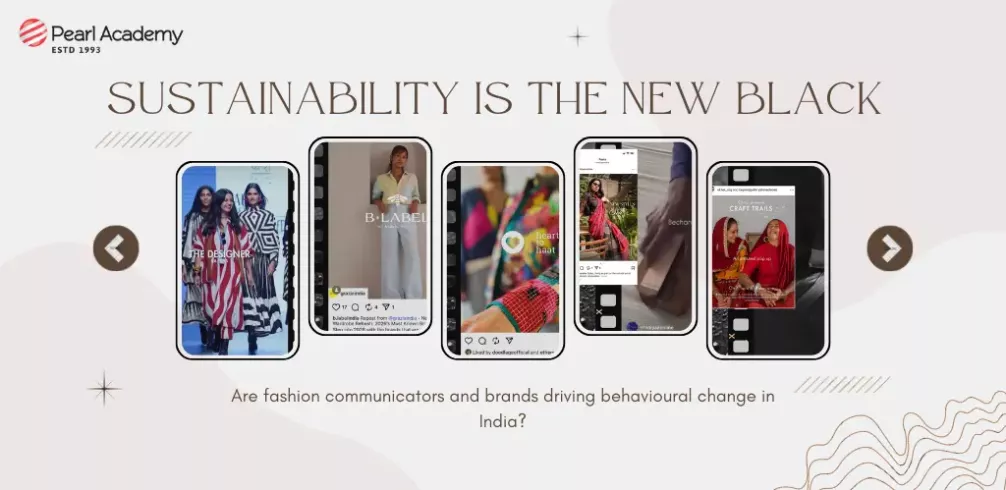
Gen Z as fashion communicators are engaged storytellers and they are fast sowing the seeds for sustainable behaviour. This could be the push required of brands and consumers to change fashion consumption patterns in India.
An article by Madhumita Ghosh.
Sustainability in fashion is no longer a buzzword or a seasonal marketing hook. In India, it is steadily emerging as a business imperative and a cultural shift. It is reshaping how clothes are designed, communicated, consumed, and valued.
Central to this transition are fashion communicators. They are rescuing sustainability from abstraction into relatable narratives, influencing consumer perception and driving meaningful behavioural change.
What was once framed as ethical choice is now becoming a behavioural norm, driven as much by storytelling and communication as by production practices.
Become future-ready with our Fashion Programs
Know More
For years, sustainability in fashion has been dismissed as a marketing cliché, reduced to green tags, vague promises, and seasonal campaigns. Today however sustainability in the Indian fashion industry has evolved into a business imperative and a cultural movement, shaped as much by communication as by production practices. As climate concerns intensify and Gen Z consumers demand accountability, fashion communicators and brands are actively influencing how Indians think, buy, use and value clothing. In this shift, sustainability is no longer just about materials or processes.
Illustration by Gauri Mittal, student of Fashion Communication, Pearl Academy 2026.
Fashion communicators are reframing sustainability in the Indian context
One of the most significant contributions of fashion communicators in India has been the localisation of sustainability narratives. Instead of relying on Western environmental discourse, brands increasingly connect sustainability to India’s own textile traditions, craft histories, and consumption patterns.
For instance, clothing brand Anavila positions handwoven khadi and linen not merely as eco-friendly fabrics but as symbols of mindful living, slow fashion and cultural continuity. Through storytelling, both on digital platforms and in brand communication, the focus shifts from “sustainable clothing” to slow, breathable, handcrafted garments that make sense for Indian lifestyles and climates.
Sustainable fashion brands are gaining increasing visibility within the fashion industry due to their strong commitment to climate neutrality, innovative business models based on recycled and upcycled materials, and the development of circularity that extend garment performance and durability.
Prioritising narrative over promotion, fashion communicators are building brands by telling stories that build emotional connection and trust instead of pushing sustainability as a moral obligation.
A strong example is Suta, which regularly highlights the weavers behind its textiles through Instagram reels, captions, and long-form interviews. By showing faces, voices, and everyday lives of artisans, the brand reframes the act of purchasing a sari or blouse as participation in a larger social ecosystem. Consumers begin to associate value not just with design, but with labour, time, and human effort, encouraging slower and more respectful consumption.
This approach subtly alters buying behaviour and customers are more likely to cherish, re-wear, and care for garments when they understand their origins.
Fashion communicators also collaborate with creators who speak the language of conscious living and thrifting. Slow-fashion stylists have been found to allow greater peer-led influence, shaping consumption choices more effectively as compared to traditional advertising.
Indian brands are also driving behavioural change by challenging the idea that newness equals value. Communicators play a crucial role in explaining and normalising alternative consumption models.
Doodlage, for example, builds its entire identity around upcycling factory waste and deadstock fabric. Through transparent communication, showing patchwork techniques, fabric sourcing, and design limitations, the brand educates consumers on why no two garments are identical and why imperfections are part of the value proposition.
Similarly, initiatives like Sustainable Fashion Forum India (SFFI) and Fashion Revolution, are creating platforms for dialogue, panels, and knowledge-sharing. They help both consumers and professionals rethink fashion systems collectively rather than individually, thereby driving a systemic change.
Beyond marketing, sustainability communication now extends into consumer experience. Labels, packaging, and store design increasingly function as learning tools.
Brands such as Nicobar integrate sustainability cues subtly, through care instructions that promote longevity and packaging that reduces waste. It puts out content that encourages mindful gifting rather than impulse buying. These small interventions influence post-purchase behaviour, encouraging consumers to maintain and reuse garments rather than discard them quickly.
As sustainability gains popularity, skepticism around greenwashing has also increased. Indian consumers, especially younger ones, expect proof, not promises. Fashion communicators are responding by embracing transparent and evidence-based communication.
Driven by digital-first communication, particularly among Gen Z. Sustainability messaging that is overly technical or moralistic tends to be rejected. Instead, brands and communicators use relatable, visual, and informal formats.
Brands like B Label (by BoAt) and Okhai use reels, behind-the-scenes videos, and user-generated content to show processes such as natural dyeing, hand embroidery, or waste reduction. These short-form narratives fit seamlessly into everyday scrolling habits, making sustainability feel accessible rather than elite.
Karishma Shahani of Ka-Sha has a sustainable brand narrative, that openly declares clothing as an expression of hand-craft, meticulously designed and crafted in India. With stores in India, Paris and pop-ups around the world, she focuses on zero-waste techniques and circular economy principles. As one of the founders of “Save the loom” project, she aligns herself closely with Fashion Revolution’s, “Who Made My Clothes.” philosophy.
Brands now share measurable data, explain trade-offs, and openly acknowledge areas where improvement is still needed. This transparency builds credibility and reframes sustainability as an ongoing journey rather than a perfect end goal.

Student Guidance Center: Our Counselors are Just a Click Away.
It is no longer a trend driven by elite consumption or global pressure. It is increasingly becoming a cultural shift, rooted in storytelling, community engagement, and conscious communication. Fashion communicators act as mediators between brands and consumers. They translate complex sustainability practices into relatable narratives that influence everyday choices. By reshaping how fashion is talked about, who makes it, how long it lasts, and why it matters, Indian brands are not just selling sustainable products, they are actively reshaping consumer behaviour, proving that sustainability is not a buzzword, but becoming a mindset which will shape the future of fashion.