The fashion industry is one of the largest environmental polluters. Every year, it uses large quantities of water for textile production, generates enormous quantities of textile waste, and emits significant amounts of carbon, all of which cause grave environmental degradation and pollution. However, it is now witnessing a shift—a conscious decision to adopt sustainable practices.
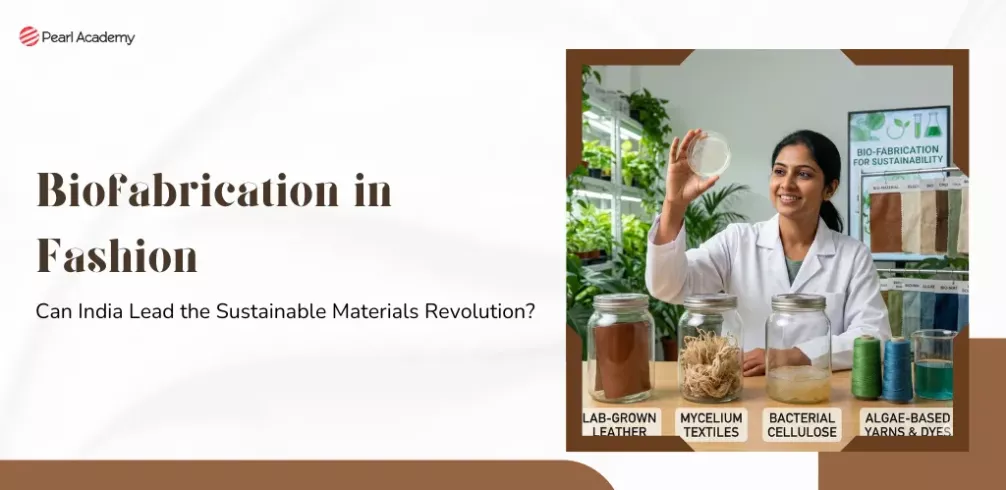
Biofabrication is one of the most promising areas for sustainability, utilising living organisms and biotechnological processes to create materials such as lab-grown leather, mycelium-based textiles, bacterial cellulose fabrics, algae-based yarns and dyes, and spider silk proteins grown through fermentation. The advantage of using biofabrics is that they are biodegradable, require less water and energy, and can be designed with minimal waste. Not only do they replace resource-intensive fabrics, but they also redefine how we imagine clothing and design (Absharina).
Become future-ready with our Fashion Programs
Know More
The Global Context
Across the globe, biofabrication is receiving immense attention and recognition as a suitable alternative. Start-ups in the United States and Europe, like Modern Meadow and Bolt Threads, have pioneered lab-grown leather and spider silk. Stella McCartney has already showcased garments made from mycelium leather, underscoring fashion’s potential to pivot from extraction to cultivation (Thomas 178). However, these technologies remain expensive, with scalability still a major challenge (Gwilt 89).
India’s diverse textile range and heritage, coupled with the latest developments in biotechnology, can soon become a driving force in the sustainable revolution. India is home to a vast variety of microbial strains, plants, and fungi—ideal for bio-based innovations. Its centuries-old practices in natural dyes, herbal treatments, and sustainable processing align with biofabrication goals. Indigenous textile clusters already work with organic and plant-based materials, providing a natural springboard. India is the second-largest textile producer in the world and already has a strong textile ecosystem.
Infrastructure and a skilled workforce can be redirected towards biotech-enhanced textile production. The Indian handloom industry has been replete with cotton, jute, and silk, materials celebrated for their durability and eco-friendliness (Ramaswamy). Because of its long tradition of usage and heritage, India has an upper hand in integrating modern biofabrication with traditional sustainable practices. Additionally, India’s strong academic institutions and research hubs are increasingly engaging with bioengineering, providing fertile ground for collaboration between science and design (Bhardwaj and Fairhurst 121).
Indian start-ups are slowly experimenting with plant-based leathers from coconut husk or banana fibres, while others work on microbial dyeing to reduce chemical effluents from textile factories (Mills-Senn). They are slowly getting the support, motivation, and direction to try their hand and bring considerable positive impacts to sustainable fashion.
When further supported by policy and investment, Indian start-ups will soon be successful in reducing the dependence on imported synthetic fibres, while scaling the Indian fashion industry to global markets. A growing start-up and research culture, and rising biotech and fashion-tech start-ups (e.g., Phabio, Biomize), are exploring plant-based polymers and bioleathers. Institutions are active in sustainability and bio-innovation research.
High research costs, lack of infrastructure for biotech-fashion integration, and limited consumer awareness are some persistent challenges in scaling up biofabrication and a sustainable Indian fashion industry. Moreover, the affordability offered by fast fashion, coupled with the opportunity to change trends, also poses a threat to the popularity of biofabrication (Niinimäki et al. 190). Without government incentives, industry–academia partnerships, and venture capital support, India risks lagging despite its potential.
For India to lead, a three-pronged approach is crucial:
- Education and Training – integrating fashion schools with biotechnology labs.
- Market Building – raising consumer awareness of bio-based products as aspirational and responsible choices. India needs to integrate biofabrication into artisan clusters and promote export and domestic sustainable materials as part of a green trade strategy.
- Policy Support – subsidies, tax incentives, and R&D funding for sustainable material start-ups. Programmes like PM-MITRA, PLI for Textiles, and Start-up India can fund biofabrication ventures. India’s circular economy roadmap encourages eco-innovation.
- By blending innovation with tradition, India can be a global R&D hub for bio-fabricated textiles.
- Build a circular textile economy by scaling bio-based alternatives and phasing out harmful synthetics.

Student Guidance Center: Our Counselors are Just a Click Away.
Biofabrication is the next frontier in sustainable fashion. It must not be reduced to a mere technological breakthrough or an innovation. It has the potential to become a cultural opportunity, merging ancient textile wisdom with modern biotechnology. India is uniquely positioned to lead the sustainable materials revolution—if the right collaborations, investments, and policy frameworks are activated. India is both globally competitive and environmentally restorative. It is truly a make-or-break situation where India must seize this moment to lead the sustainable materials revolution.
References
- Absharina, D., Padri, M., Veres, C. and Vágvölgyi, C., 2025. Bacterial Cellulose: From Biofabrication to Applications in Sustainable Fashion and Vegan Leather. Fermentation, 11(1), p.23.
- Niinimäki, K., Peters, G., Dahlbo, H., Perry, P., Rissanen, T. and Gwilt, A., 2020. The environmental price of fast fashion. Nature reviews earth & environment, 1(4), pp.189-200.
- SACHDEV, L., KAUSHIK, K. and SRIVASTAVA, H., 2025. BIOMANUFACTURING FOR SUSTAINABLE GROWTH AND DEVELOPMENT IN VARIOUS SECTORS-A REVIEW. Journal of Phytological Research, 38(1).
- Bhardwaj, Vertica, and Ann Fairhurst. “Fast Fashion: Response to Changes in the Fashion Industry.” The International Review of Retail, Distribution and Consumer Research, vol. 20, no. 1, 2010, pp. 165–173.
- Gwilt, Alison. Fashion Design for Living: Sustainability in Practice. Routledge, 2014.
- Mills-Senn, Pamela. “Dyeing for Change: Companies Create Pollution Solutions.” Fabric Architecture, vol. 29, no. 6, June 2023, fabricarchitecturemag.com/2023/06/01/dyeing-for-change-companies-create-pollution-solutions/.
- Ramaswamy, Vijaya. Textiles and Weavers in South India. 2nd ed., Oxford University Press, 2006. Thomas, Dana. Fashionopolis: The Price of Fast Fashion and the Future of Clothes. Penguin Press, 2019.