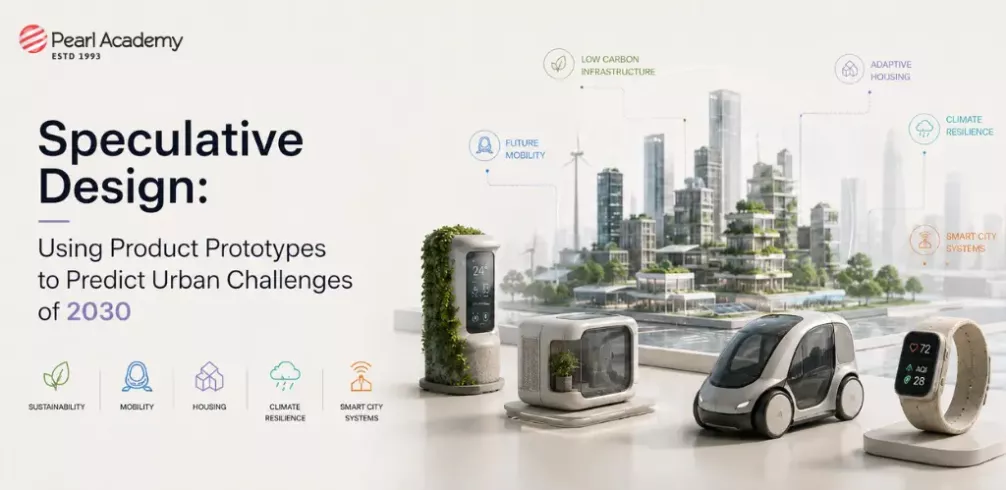
Have you ever wondered what the world will look like a hundred years from now? There is no one possible answer to the question; rather, several possibilities could exist based on how the world progresses and humanity exists. This is where a design approach known as Speculative Design comes into the picture. Speculative design explores questions such as what will the future hold based on what we have today. The design process includes deep research, technological understanding, and prototyping to create several possible future scenarios. Speculative Design Prototyping for Urban Challenges of 2030 is emerging as an innovative approach that helps designers, researchers, and policymakers explore future possibilities before they become reality.
Speculative designs are not aimed at giving a solution; rather, they present imaginary possible scenarios to spark discussions, debates, and thought processes to address present socio-economic challenges.
Become future-ready with our Communication Design Programs
Know More
Popularized by designers Anthony Dunne and Fiona Raby, speculative design is a method of exploring what the future will look like based on present trends. Speculative designs are not concerned with exploring answers for the future; rather, they question assumptions, imagine alternative future possibilities, and provoke debates around the future by giving multiple scenarios based on different situations. Speculative design challenges traditional design theories by treating the future as a subject and building products not for customers of today, but rather for an imaginary future.
Creative thinking, storytelling, and setting up a narrative are some of the core parts of speculative design through which designers can present ideas, conversations, and offer a unique perspective for the future.
Product prototyping is the practice of developing design components that are not currently in use but are intended to examine a potential future state from one or more perspectives. A product prototype's goal is to interact with potential future solutions rather than to forecast the future. In speculative designs, the prototypes are not functional products and are referred to as “provotypes” (provocative prototypes). Provotypes in speculative designs act as:
- Storytelling devices
- Thought experiments made physical
- Tools for public debate
- Simulations of future lifestyles
Understanding the purpose and what speculative design aims to achieve is essential before trying to understand its applications and importance. The following are some of the major goals of speculative design:
1. Challenging the status quo: Through designs that are inspired by “what if” scenarios, speculative design works as a channel for challenging the status quo and raising important questions around accountability. Speculative design becomes a way of critiquing the present day of cultural, political, and social establishments.
2. Exploring the possibilities: Speculative design takes several scenarios into account to present different possibilities of the future. It explores what is possible, what is probable, and even what is preferable.
3. Provoking debate and public discussion: Through presenting bold and diverse future possibilities, speculative designs provoke debate across different public platforms and channels.
4. Realizing social responsibility and ethical considerations: Finally, an important aim of speculative design is to spark conversations around collective social responsibility and social, cultural, and environmental considerations. Speculative design provotypes also encourage evaluating present ethical considerations and their possible future implications.
A lot of deep research and understanding goes into creating a speculative design. The entire process can be divided among multiple steps:
1. Horizon Scanning
Before starting a speculative design product, designers carry out detailed research on the concept. This initial research process is called horizon scanning, and includes understanding historical background, current trends, technology developments around the subject, changing trends, and social implications.
Designers often use the STEEPLED (Social, Technological, Economic, Environmental, Political, Legal, Ethical, and Demographic factors) framework to organize their research.
2. Building Future Possibilities
Following the initial research phase, the next step in speculative design is to build future scenarios based on questions such as “what if” and “how”. The future scenarios are not predictions; rather, they are possibilities based on current trends. Through these imaginative scenarios, designers explore how societies may be shaped if current trends remain. Designers may create several different scenarios based on different possibilities.
3. Creating Artifacts
Designers then use these scenarios to create artifacts or concepts that transform imaginary scenarios into possible concepts such as products, apps, services, interfaces, environments, or systems.
4. Product Prototyping
The prototyping process requires designers to preserve artifacts as observable ideas that are aimed at sparking debate, discussion, or provoking a thought process among observers. There are several methods of product prototyping; often designers preserve these artifacts in digital spaces, or keep them in exhibitions, publications, articles, etc.
5. Publishing and Documenting
A proper documentation of a speculative design is essential as it ensures that ideas, research methodologies, and concepts are conveyed to the observer with clarity. A detailed documentation also helps in preserving the prototype for future use.
7. 6Feedback Public Discussion, Critiquing
Constructive feedback on a speculative design is essential, as the idea of the design heavily relies on public perspectives and reactions. Designers must question whether the design asks important questions of the audience, or whether it sparks public debate or discussion.
Speculative designs follow a certain number of core principles that dictate the design process, approaches, and methods used to create artifacts. The following are the core principles of Speculative Design process:
1. Ask “What If” not “What Is”
Speculative Design changes the design perspective from what is happening now to what could happen if certain conditions are applied. Therefore, the fundamental principle of speculative design is to ask, “what if,” instead of “what is.” The artifacts created through speculative design explore what might happen if society follows certain technological, social, or current trends, and how it will shape over a period of time. This allows designers to have several possible scenarios.
2. Provoke, Disrupt, and Spark Discussion
The idea of speculative design originates from exploring several different possibilities; therefore, design principle requires designers to provoke observers, disrupt their thinking process, and eventually spark a discussion on current situations and possible future outcomes.
3. Futures Cone Framework
The Futures Cone framework was conceptualized by Joseph Voros. This framework classifies the future possibilities of a speculative artifact into five categories::
- Possible
- Plausible
- Probable
- Preferable
- Projected
4. Collaboration
Speculative Design requires deep research across different fields, and thus interdisciplinary collaboration is essential for a design to be conceptualized. A designer working on a speculative artifact may have to collaborate with researchers, scientists, activists, writers, and members of society to create the most intriguing speculative designs.
5. Juxtaposition of Concepts
Speculative Designs often find themselves at a juxtaposition, as they may be inspiring and, at the same time, grotesque. This contrast is often a core element of the design process as it provokes observers to question, discuss, and be inspired.
6. Ethical Considerations
Since the designs are created to depict future possibilities based on today’s technology, science, social norms, and communities, taking ethical considerations into account is crucial. Designs must convey who will be benefited in the future or what social class may face challenges.
In order to comprehend urban futures, speculative design prototyping is becoming a crucial tool. Instead of making precise predictions about how cities will appear in 2030, it allows people, policymakers, and designers to discuss the social implications of emerging technology, explore opportunities, and highlight concerns.
Speculative design is a potent tool for creating more resilient and sustainable urban futures because it allows cities to better prepare for issues like climate change, mobility, housing, resource management, and human well-being through future-focused prototypes.
As per the current technological, environmental, and social trends, the following are some of the possible urban challenges that the world is likely to be facing in 2030:
- Climate change
- Heat islands
- Water scarcity
- Waste management
- Urban mobility
- Housing shortages
- Air pollution
- AI governance
- Aging population
- Food security
The following table details possible speculative prototypes for future urban challenges.
| Challenge | Example Speculative Prototype |
| Climate change | Personal flood prediction wearable |
| Heat islands | Smart cooling street furniture |
| Water scarcity | Household water-credit dashboard |
| Waste management | AI-powered neighborhood recycling robot |
| Urban mobility | Autonomous micro-transit pod |
| Housing shortages | Modular adaptive housing unit |
| Air pollution | Personal air-quality ecosystem device |
| AI governance | Citizen-controlled urban AI dashboard |
| Aging population | Autonomous care-assistance products |
| Food security | Hyperlocal vertical farming appliance |
Speculative Designs offer a unique, creative, and innovative design challenge to both designers and students. Through speculative designs, both designers and students benefit as the process requires them to research, plan, collaborate, and explore new ideas. The following are some of the key reasons why speculative designs are essential for designers and students alike:
1. Encourages Future-Oriented Thinking
Speculative Design requires designers and students to ask tough questions and think out of the box to imagine several possible scenarios for one particular use case. This approach requires future-oriented thinking and the ability to imagine possibilities based on current scenarios.
2. Develops Critical and Creative Thinking
The Speculative Design process requires students and designers to critically evaluate trends, subjects, social behaviors, technological developments, and socio-economic developments. Furthermore, the design process also converts these critical observations into creative possible outputs. This unique approach allows students and designers to brainstorm and develop a deep critical and creative ability.
3. Help Designers Understand Social Trends
Through the speculative prototyping process, designers have to research the context of current societal trends. Often, research and subject study require designers to interact with members of communities and understand how different socio-economic, political, technological, and other trends are shaping societies.
4. Combines Design and Technologies
Speculative prototyping is achieved using several technical tools and modern technologies such as Artificial Intelligence, Virtual and Augmented Reality, Internet of Things (IoT), Robotics, Biotechnology, and sustainable materials. This process blends complex design elements and modern technology to produce prototypes that are believable in a future context.
5. Encourages Sustainability and Responsible Design
Speculative designs are aimed at sparking meaningful discussions about future possibilities and avoiding the adverse consequences of current trends. Innovative designs often encourage sustainable practices and responsible design techniques by limiting environmental consequences during the conceptualization process. Furthermore, designs often explore scenarios that concern current and future challenges such as climate change, resource scarcity, urban overcrowding, waste management, and energy consumption

Student Guidance Center: Our Counselors are Just a Click Away.
6. Promotes Interdisciplinary Learning and Collaborations
Throughout the composition of a speculative design, students and designers are required to collaborate with professionals from different disciplines. Often, researchers, scientists, writers, activists, social workers, and members of society are part of the design process.
Because it enables designers and students to think beyond the present, investigate potential futures, and critically assess the social, ethical, technological, and environmental ramifications of innovation, speculative design is crucial. Speculative design trains the next generation of designers to develop solutions that are not just creative but also responsible, sustainable, and human-centred by fusing creativity with research and strategic thinking. It is becoming a crucial ability for everybody involved in influencing the future of goods, services, experiences, and cities in a world that is changing quickly.
References