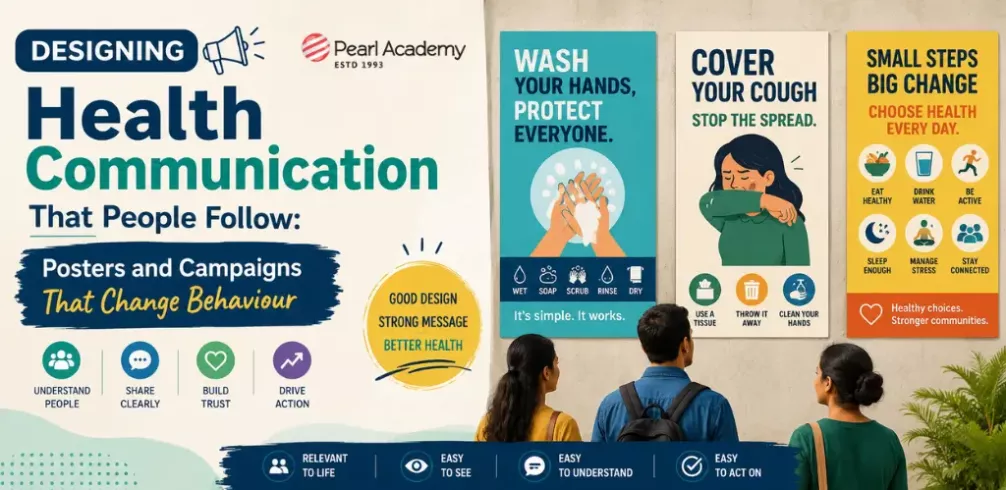
Health communication plays a critical role in shaping public behaviour, particularly in areas related to hygiene, vaccination, preventive care, and lifestyle choices. However, not every campaign succeeds in influencing people’s actions. While some posters and awareness drives remain unnoticed, others manage to transform habits, establish social norms, and encourage long-term behavioural shifts. Across hospitals, metro stations, schools, and public spaces, people encounter countless messages promoting actions such as handwashing, vaccination, quitting smoking, or maintaining public hygiene. Yet only a limited number of these campaigns create measurable behavioural impact.
This distinction highlights the importance of behaviour change communication (BCC), an approach that combines visual design, psychology, sociology, and communication strategy to encourage meaningful action. Rather than merely informing audiences, behaviour change communication seeks to influence how individuals perceive social norms and how they respond within collective environments. One of the most significant psychological principles supporting such campaigns is social proof psychology, which suggests that people are more likely to adopt behaviours when they observe others engaging in them.
Become future-ready with our Communication Design Programs
Know More
Traditional health communication campaigns often operate on the assumption that awareness automatically results in behavioural action. However, behavioural science demonstrates that knowledge alone is rarely sufficient to produce change. Individuals may fully understand what constitutes healthy behaviour yet fail to act because of ingrained habits, lack of motivation, social pressures, or environmental influences.
Behaviour changes communication addresses this gap by focusing not only on information dissemination but also on behavioural triggers, emotional engagement, and social influence. Research in public health communication indicates that mass-media campaigns generally produce modest behavioural changes, often between 5–6 percent. Nevertheless, even small behavioural shifts at a population level can generate substantial public health outcomes.
At the same time, poorly designed communication strategies may lead to unintended consequences. Several European vaccination campaigns, for instance, demonstrated that ineffective messaging could reduce public willingness to vaccinate rather than increase it. Such findings emphasize that successful health communication depends not only on what is communicated but also on how the message is framed, visually presented, and socially contextualized.
Social proof psychology refers to the tendency of individuals to imitate the behaviour of others, particularly in situations involving uncertainty or risk. In the context of health communication, this principle becomes especially significant because people often look toward collective behaviour to determine what is acceptable, safe, or socially responsible.
Health campaigns grounded in social proof psychology typically communicate the following ideas:
- People are more likely to adopt behaviours when they observe others doing the same.
- Social norms simplify decision-making processes.
- Collective participation increases individual confidence and trust.
As a result, the central question shifts from “Why should I do this?” to “Why is everyone already doing this?” This subtle transformation in perception can significantly increase compliance and behavioural adoption.
The global COVID-19 pandemic provided one of the strongest contemporary examples of behaviour change communication in practice. Governments and public health organizations worldwide implemented large-scale campaigns to encourage vaccination, often relying heavily on social norm messaging and community participation.
South Korea emerged as a notable example, where communication strategies emphasizing collective responsibility, public participation, and social trust contributed to exceptionally high vaccination rates. Studies reported that approximately 94.8% of the population received two vaccine doses through campaigns that strategically integrated social marketing principles and culturally contextual messaging.
Similarly, global research on vaccination campaigns has demonstrated that community-oriented and socially driven messaging significantly improves vaccine acceptance. These campaigns were effective not merely because they provided medical information, but because they framed vaccination as a shared social responsibility and a normalized public behaviour.
The rise of digital media has transformed the landscape of public health communication. Social media platforms now function as influential spaces for health awareness, enabling campaigns to reach diverse audiences rapidly and interactively.
An important example is the #Vax4Community campaign implemented in New York, which utilized digital storytelling and peer-generated narratives to address vaccine hesitancy. The campaign generated more than 1.9 million impressions, reached nearly 700,000 users, and encouraged thousands of engagements through relatable storytelling techniques.
The success of such campaigns demonstrates how digital platforms amplify the effectiveness of social proof psychology. When individuals encounter testimonials, personal stories, and visible community participation online, health behaviours appear more relatable, trustworthy, and socially accepted. In this way, digital storytelling strengthens emotional engagement while simultaneously reinforcing collective norms.
Designing Posters and Campaigns That Influence Behaviour
If social proof psychology provides the behavioural foundation, design acts as the mechanism through which communication becomes effective. Posters and public awareness campaigns capable of influencing behaviour generally share several important characteristics:
1. Emphasizing Majority Behaviour
Campaigns that communicate widespread participation tend to increase behavioural compliance. Statements such as “Most people in your community are already vaccinated” create a sense of collective acceptance and social expectation.
2. Using Relatable Visual Representation
Visual representation significantly affects trust and identification. Audiences respond more positively when campaigns include familiar faces, culturally relevant imagery, and socially recognizable contexts.
3. Simplifying Communication
Clear and concise messaging is essential in public health design. Simple visual structures, direct calls to action, and minimal textual complexity improve comprehension and retention.
4. Repetition and Consistency
Behavioural change rarely occurs through a single exposure. Repeated visual communication across multiple environments reinforces memory and gradually normalizes desired behaviour.
5. Leveraging Trusted Community Voices
Messages delivered by healthcare professionals, local leaders, teachers, or respected public figures often achieve greater credibility and acceptance within communities.
Together, these principles demonstrate that successful health communication depends on the integration of behavioural psychology with strategic visual design.
Although social proof psychology is highly influential, its misuse can produce negative outcomes. Poorly framed campaigns may unintentionally reinforce harmful behaviour, spread misinformation, or reduce institutional trust. This challenge has become increasingly visible in digital environments where misinformation can rapidly reach millions of individuals and shape public perceptions regarding health practices.
Therefore, ethical behaviour change communication must balance persuasion with factual accuracy, transparency, and cultural sensitivity. Public health campaigns should encourage informed decision-making rather than manipulation or fear-based compliance.

Student Guidance Center: Our Counselors are Just a Click Away.
The most effective health communication campaigns do not rely solely on the transmission of information; they rely on influence, participation, and social normalization. Posters and campaigns that successfully change behaviour achieve more than awareness creation. They make actions appear visible, socially accepted, and achievable within everyday life.