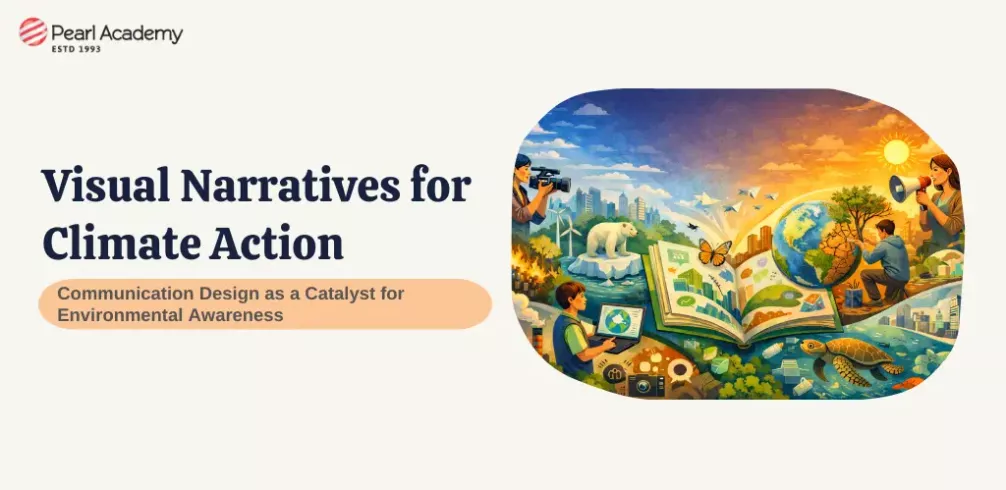
Remember the last climate post on your phone that you actually looked at? Was it a lengthy article or a 10-second reel showing a river darkening, a thermometer increasing, or a child jumping over cracked earth? Most of us don’t remember the number of degrees; we remember the feeling the photo conveyed. This is the quiet power of visual narratives, and it is where communication design can become a real tool for climate action.
Become future-ready with our Communication Design Programs
Know More
Global warming sometimes appears to be something far away, a matter of science (PPM, scenarios, COP meetings) and politics. Visual narratives have the power to bridge that gap. The research shows that concrete and relatable images make people feel the risk of climate to be more real than just abstract graphs (Nicholson-Cole, 2005). To put it simply, visuals are not only the means of presentation in climate messages. They determine whether people will be interested.
Not every severely dramatized image is helpful. A repeated exposure to a certain number of polar bears can cause fatigue or fear without a sense of control (O’Neill & Nicholson-Cole, 2009). Usually, successful visual narratives do the following three things:
- Show real people
Everyday scenes, such as a farmer adjusting irrigation or students biking on a car-free day, invite identification. - Connect cause, impact and solution
For example, a three-frame story: traffic jam, smoggy skyline, then the same street with buses and trees. - Make action look possible
Visuals that include practical steps, such as “switch, share, support”, are more empowering than disaster images alone.
Typing, colour, and setting here are not visual or cosmetic options. They help to guide the viewer’s feelings, concentration, and recollection.
Climate narratives are everywhere in daily culture if you just look for them:
- Streaming services are home to brief animated films that depict a city becoming green as the inhabitants alter their habits.
- Many cities' street murals now meld local folklore with the portrayal of the rising water or vanishing trees.
- You might receive utility bills with an easy-to-understand infographic that compares your energy consumption to that of your neighbours.
None of these depend on lengthy explanations. They work because they come from the familiar and gradually change the viewer's perception of what is normal and what is in danger (Sheppard, 2012).
Needing not a grand campaign, one can simply start a powerful movement by asking oneself a few questions concerning the work:
- Start from a real place. Show a market, street or home your audience already knows.
- Anchor the story in a human moment.
- Add one clear invitation- Save water today, take the bus once a week, support a local restoration project.
Think of each poster, reel, or infographic not as mere warnings about the present but as invitations into a different future.

Student Guidance Center: Our Counselors are Just a Click Away.
Climate models, laws and technologies are essential, but they do not move people on their own. Visual narratives give climate change a face, a place and a path forward. Designers cannot solve the crisis alone, yet they can do something vital. They can help societies see the future clearly enough that doing nothing no longer feels like an option.
References
- Nicholson-Cole, S. A. (2005). Representing climate change futures: A critique on the use of images for visual communication. Computers, Environment and Urban Systems, 29(3), 255–273.
- O’Neill, S., & Nicholson-Cole, S. (2009). “Fear will not do it”: Promoting positive engagement with climate change through visual and iconic representations.
- Science Communication, 30(3), 355–379. Sheppard, S. R. J. (2012). Visualizing climate change: A guide to visual communication of climate change and developing local solutions. Routledge.