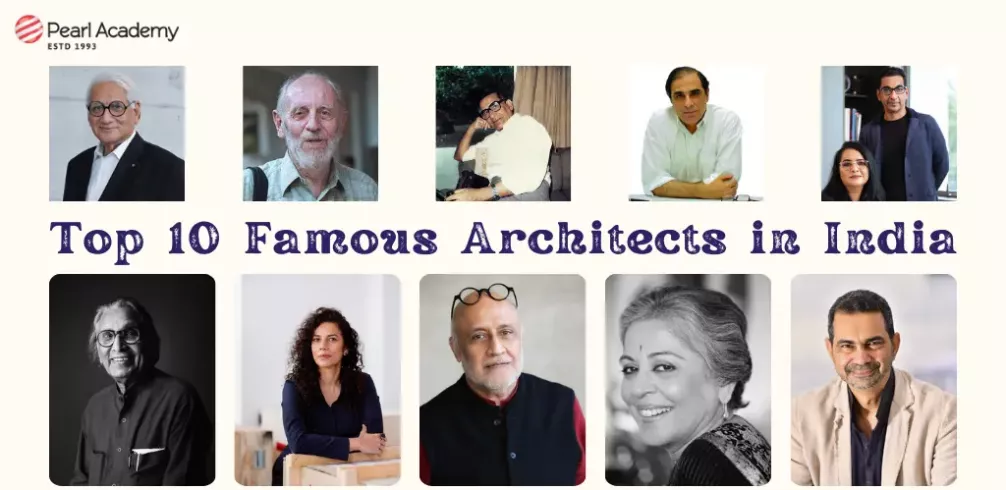
India’s buildings tell a living story. They respond to heat and rain, celebrate local craft, and bring communities together. From post-Independence campuses to today’s climate-wise housing, Indian architects have tried to make places that work thermally, socially, and culturally. This guide introduces ten famous architects in India, and if you want a deeper understanding of the types of architecture that shaped their work, explore our detailed guide on architectural styles..
Become future-ready with our Interiors Programs
Know More
India is a restless laboratory of ideas. On any street you can find a lesson in climate, a detail in brick, or a new way to gather people. Here are ten minds who shaped that spirit.
1) B. V. (Balkrishna) Doshi (1927–2023)
Image Courtesy: Architectural Digest
Life and approach: Trained at Sir J. J. School in Mumbai. Worked with Le Corbusier and Louis Kahn early in his career. India’s first Pritzker laureate in 2018. He joined joy with social purpose and always began with climate.
Why he matters: He showed how campuses and housing can be generous, shaded, and humane.
Study this: Aranya Low-Cost Housing in Indore and IIM Bangalore. Look for courtyards, shaded corridors, and spaces that grow with people.
2) Charles Correa (1930–2015)
Image Courtesy: Dezeen
Life and approach: A leading voice after Independence. He linked modern construction to Indian cosmology and daily life.
Why he matters: He turned climate, ritual, and movement into clear plans and sections.
Study this: Kanchanjunga Apartments in Mumbai, a “vertical bungalow” with deep verandas. Also visit the Gandhi Smarak Sangrahalaya at Sabarmati Ashram, a quiet sequence of pavilions around water.
3) Laurie Baker (1917–2007)
Image Courtesy: Kerala.com
Life and approach: British-born, made India his home. Guided by Quaker values and Gandhian ideas. Worked largely in Kerala.
Why he matters: He championed low-cost, low-energy construction using local brick, filler slabs, and passive cooling long before the word “sustainable” became popular.
Study this: Centre for Development Studies in Thiruvananthapuram. Notice the brick lattices, cross ventilation, and comfort without expensive systems.
4) Mahendra Raj
Image Courtesy: Archpaper
Life and approach: Mahendra Raj brought bold structural thinking.
Why he matters: He turned structure into public space and planned for climate at city scale.
Study this: Hall of Nations at Pragati Maidan in New Delhi. It was one of the earliest and largest cast-in-place space frames in reinforced concrete. It stood as a symbol of national ambition.
5) Hafeez Contractor (born 1950)
Image Courtesy: Architect and Interiors India
Life and approach: One of India’s most prolific contemporary architects.
Why he matters: His practice helped define the corporate campus, the large stadium, and the modern high-rise in the era of liberalization.
Study this: DY Patil Stadium in Navi Mumbai and 23 Marina in Dubai. Together they show range from sports infrastructure to luxury residential towers.
6) Anupama Kundoo (born 1967)
Image Courtesy: Ribaj.com
Life and approach: Educated at Sir J. J. and completed a PhD at TU Berlin. Based in Auroville.
Why she matters: Her work blends research and building on site. She prototypes fast, affordable, and ecological construction with local materials and community hands.
Study this: Wall House in Auroville. It doubles as a laboratory for structure, craft, and climate. A full-scale version was later exhibited at the Venice Biennale.
7) Brinda Somaya (born 1949)
Image Courtesy: Rethinking Civil Society
Life and approach: A pioneer of conservation-led design in India.
Why she matters: She argues that an architect serves society. Her projects bring heritage back to public life with dignity.
Study this: Restoration of St. Thomas’ Cathedral in Mumbai, a UNESCO Asia–Pacific Heritage Award winner. Study how careful research and good craft renew a civic landmark.
8) Rahul Mehrotra of RMA Architects
Image Courtesy: Harvard University
Life and approach: Teacher and practitioner. He studies the “kinetic city,” informal urbanism, and landscape.
Why he matters: He designs with water and time in mind and treats landscape as infrastructure.
Study this: Hathigaon in Jaipur. Lakes capture monsoon water first, then modest housing follows. Ecology and settlement act together.
9) Sanjay Puri (born 1965)
Image Courtesy: Architect and Interiors India
Life and approach: Known for sculptural forms that work hard in hot climates.
Why he matters: He proves that form can be a climate device. Orientation, shade, and airflow are the drivers.
Study this: The Rajasthan School near Nagaur and The Street hostel in Mathura. Watch how the buildings fold to make shade and bring in north light.
10) Morphogenesis founded by Sonali and Manit Rastogi
Image Courtesy: MGS Architecture
Life and approach: Practice founded in 1996.
Why they matter: They translate vernacular logic into measurable performance at scale. Water, shade, and social space come first.
Study this: Pearl Academy, Jaipur. The double skin with jaali, the step-wells, and the cool undercroft show passive cooling at work in a hot-dry climate.
Architectural designing is all about creativity. As an architect, you must have the skills to be able to visualize the potential of a space and bring that vision to life.
- Begin with a section, not a façade. Sketch one clean section. Mark courts, verandas, shaded corridors, and wind paths. You will understand how the building breathes before you look at the elevation.
- Trace climate moves. Use a colored pen to mark sun, shade, and air. Note north light in classrooms and deep overhangs that cut glare.
- List materials and reasons. Ask why the architect chose brick, lime, stone, or concrete. Link each choice to cost, carbon, maintenance, and local skill.
- Read structure as space. Identify the main span and how people move within it. In the Hall of Nations the structure is the architecture.
- Look at landscape first. In Hathigaon, water bodies and earthworks come before walls.
Conserve to modernize. In Somaya’s work, restoration returns buildings to public use. The old fabric gains new life.
From nation-building to climate-building. Early decades after Independence focused on public institutions and exhibitions that gave shape to a young nation. The 1990s brought private campuses and large housing. At the same time, Kerala and Auroville kept a culture of frugal, material-wise building alive. Today the frontier is tropical performance. Designers place shade, water reuse, and passive cooling at the center of the brief. Expect more landscape as infrastructure and more conservation as a city strategy as heat waves grow and water cycles shift.
Studios to watch. Beyond our ten, look for practices that work with craft clusters, restore small civic buildings, and build regional vocabularies. The field is becoming more plural, more local, and more climate literate.
If you want training that ties climate, craft, and community to real studio practice, explore the B.Des in Interior Architectural Design at Pearl Academy. The Pearl Academy, Jaipur campus by Morphogenesis is itself a living classroom for passive cooling, courtyards, and water-wise design. You will learn to read sites like a scientist, think like a craftsperson, and detail like a civic designer.
Embarking on a Bachelor of Interior Architectural Design is not just about earning a degree; it's a transformative journey that unlocks your creative potential.

Student Guidance Center: Our Counselors are Just a Click Away.
The most lasting works by the famous architects in India do not rely on spectacle. They last because they respect climate, honor local skill, and give everyday life dignity. From Doshi’s courtyards and Correa’s verandas to Baker’s brickwork and Morphogenesis’s step-wells, the best Indian buildings turn constraints into culture. As our cities grow denser and hotter, the next generation will be judged less by how loudly a building looks and more by how quietly it works for people and place.
You may also like: