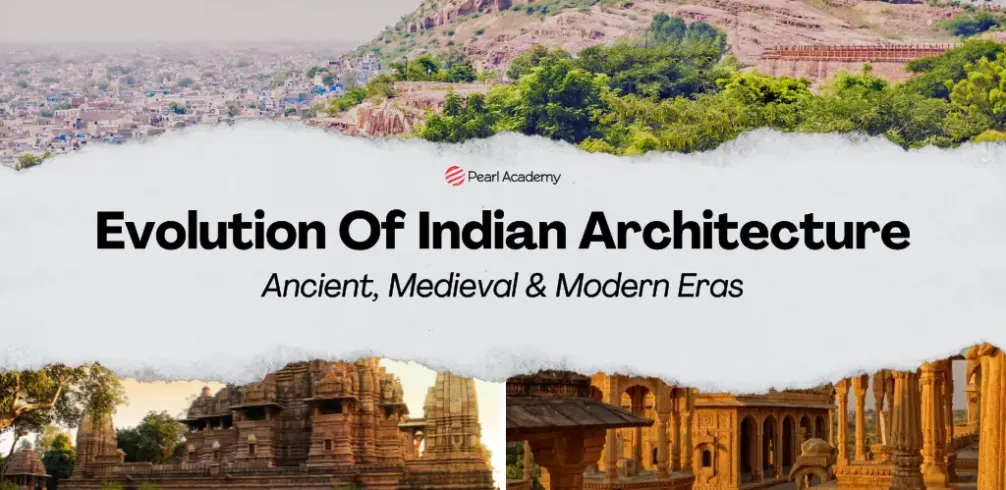
Indian architecture is forever evolving! If you analyse carefully, the types of Indian architecture that have been existing across centuries and timelines, you will find they are diverse, stylistic, and extremely scientific in their uses and forms. Stand in front of the Taj Mahal at sunrise, walk through a narrow pol in old Ahmedabad, or drive past a glass-fronted IT park in Bengaluru, and you are seeing different centuries of Indian architecture in a single frame. India’s built environment is not one story but many, layered across time, faith, power and everyday life.
This blog takes you on a calm, chronological walk through the history of architecture in India, from ancient to medieval to modern, while weaving in the role of interior architecture and how a programme like Pearl Academy’s B.Des in Interior Architectural Design can help you turn this fascination into a serious career path.
History of Architecture in India: the long view
Amber Fort, Jaipur Rajasthan (Image Source: Pinterest)
If you zoom out, the history of architecture in India can be seen as a conversation between three big forces: geography, belief and technology. Rivers and mountains shaped early settlements; religions and empires shaped forms and symbols; new materials and construction methods reshaped skylines again.
Broadly, historians talk of three overlapping phases. The ancient phase introduces planned cities, stupas, caves and the first stone temples. The medieval phase sees temple building reach extraordinary complexity and Indo-Islamic architecture transform the way space, light and gardens are used. The modern phase brings colonial experiments, post-independence modernism and today’s glass, steel and sustainable buildings.
Within this large arc, each region and community has added its own vocabulary, which is what makes Indian architecture feel so endlessly rich to a design student walking through it today.
Harappa and Mohenjo Daro city (Image Source: Pinterest)
When we speak of Ancient Indian Architecture, most journeys begin with the Indus Valley civilisation. Cities like Harappa and Mohenjo Daro show us that as early as 2500 BCE, people were already thinking in grids, hierarchies of roads, standardised bricks and sophisticated drainage.
These were not random clusters of houses; they were carefully choreographed urban systems. Streets intersected at right angles, houses opened into internal courtyards, and public baths and granaries served collective needs. Even in this early moment, architecture was less about “monuments” and more about how people lived, bathed, stored grain and moved through space.
As political and religious landscapes changed, built forms changed too. Under the Mauryas and early Buddhist traditions, stupas, monolithic pillars and rock-cut caves came into focus. Later, early Hindu and Jain shrines developed the core elements—sanctum, hall and tower—that would dominate sacred building for centuries. Ancient Indian architecture, in that sense, is where both city planning and ritual architecture first take clear shape and forms the foundation for several architectural styles explained in our types of Architecture guide.
If you look closely at ancient architecture in India, you start to see a shift from largely brick-and-mud construction to an intense engagement with stone.
Stupas like those at Sanchi are deceptively simple from a distance: a dome, a railing and gateways. But as you walk around them, the rhythmic reliefs, ordered pathways and clear axiality show how architecture was used to support meditative movement.
Ajanta and Ellora caves (Image Source: Pinterest)
Rock-cut caves at places like Ajanta and Ellora push this further. Entire halls, columns, façades and even “wooden” details are carved out of living rock. Instead of stacking materials up, architects and artisans removed material to reveal space within a hill. These caves are not just technical feats; they are early lessons in how light, sound and proportion can create powerful interior experience.
The earliest structural temples take shape in this period as well. Their forms are still relatively compact, but the idea of a sacred core, approached through layers of space, is firmly in place. For anyone considering interior architecture, these ancient spaces are an early reminder that volume, light and movement can be as important as decoration.
The story of Indian Temple Architecture is almost a parallel history of India itself. As dynasties rose in north, south, east and west, each region developed its own way of expressing the relationship between human and divine in built form.
Sun Temple, Konark(Image Source: Pinterest)
In northern regions, the Nagara style took shape. Here, the most striking feature is the curving shikhara—the tower that rises above the sanctum like a vertical mountain. Temples such as those at Khajuraho or the Sun Temple at Konark carry this profile, often on raised platforms, with intricate carvings and a tightly knit composition of subsidiary shrines and halls.
In the south, the Dravida style emerged, with its stepped pyramidal vimanas and towering gopurams at the entrances to temple complexes. In places like Thanjavur and Madurai, these gateways become landmarks for entire cities. They are covered in sculptures, painted and repainted over generations, turning architecture itself into a living skin of stories.
Between these poles, a third family, often called Vesara, appeared in the Deccan region. Temples built by the Chalukyas and Hoysalas, for instance, play with star-shaped plans, profusely carved columns and richly layered projections. Taken together, Indian temple architecture shows how geography, material and ritual can generate astonishing diversity within a shared spiritual framework.
Indian Art and Architecture: when buildings become storytelling
The phrase Indian Art and Architecture hints at something important: in many Indian contexts, art is not a separate “add-on” to a building but integrated into its very fabric.
The walls of a temple double as narrative panels for epics and local legends. Caves at Ajanta carry murals of courtly life, trade and devotion, turning dim rock-cut interiors into glowing theatres of colour. Jain temples dazzle with marble lacework, while Buddhist stupas once wore layers of painted reliefs.
Qutb Minar, Delhi (Image Source: Pinterest)
Later, in the medieval period, calligraphy, floral inlay, jali screens and garden layouts work together to create Indo-Islamic and Mughal complexes where script, stone, water and greenery are all part of the same artistic language.
For an aspiring interior architect, this fusion is a reminder that surfaces, furniture, graphics and even planting can all participate in storytelling. A hotel lobby, a co-working space or a museum can borrow this same principle: structure sets the stage, but art and craft make the experience memorable.
By the time we reach the medieval period, Indian architecture styles become more layered and hybrid. The arrival and establishment of Islamic rule in various parts of the subcontinent brings new structural techniques and spatial ideas that begin to converse with existing traditions.
Taj Mahal, Agra (Image Source: Pinterest)
Indo-Islamic architecture introduces the true arch and dome in stone, large congregational courtyards and carefully oriented prayer halls. Sultanate buildings play with soaring gateways, robust stonework and rich surface ornament. As Mughal power grows, this language becomes more refined: white marble, red sandstone, charbagh gardens, mirrored symmetry and delicately carved jalis transform the way palaces, tombs and gardens are conceived.
Lake Pichola, Udaipur (Image Source: Pinterest)
At the same time, Rajput rulers and other regional powers continue to build forts, palaces and havelis in styles that draw from both local traditions and these new influences. Hilltop citadels in Rajasthan, lakeside palaces in Udaipur, stepwells in Gujarat and courtyard houses in old city cores all belong to this tapestry. What emerges is a distinctly Indian blend, where the same arch or column might carry meanings from multiple cultures.
Within that medieval tapestry, the types of arches in Indian architecture become an interesting study by themselves. Each type of arch is not only a structural solution but also a visual signature.
Earlier buildings often relied on corbelled openings, where stones project out layer by layer to bridge a gap. Islamic builders popularised the true arch, built with wedge-shaped stones that distribute loads more efficiently. Pointed arches became common in mosques and tombs, while horseshoe and multifoil arches added complexity and rhythm to façades and interiors.
Victoria Memorial, Calcutta (Image Source: Pinterest)
Later, in colonial and Indo-Saracenic buildings, you see scalloped or cusped arches used on verandas, galleries and pavilions, sometimes purely as a stylistic nod to the subcontinent’s past. For a design student, learning to “read” these arches is a bit like learning a new alphabet: once you recognise the shapes, you start seeing patterns in old cities and new developments alike.
While palaces, mosques and temples attract cameras, traditional Indian architecture also lives quietly in village streets and older neighbourhoods, where ordinary people adapted materials and forms to climate and culture.
In hot, dry regions, thick mud or stone walls, internal courtyards and shaded verandas keep interiors cool without mechanical systems. In coastal and high-rainfall areas, steeply sloping tiled roofs, raised plinths and deep overhangs protect houses from heavy showers. In the North-East, stilted bamboo structures allow floodwater to pass beneath. In the Himalayas, stone-and-timber construction helps retain warmth.
None of these houses were designed by “star architects.” They evolved through trial, error and collective memory. Yet they embody many ideas now discussed under sustainability and bioclimatic design: local materials, passive cooling, low embodied energy and close connection to landscape. For interior architecture, this vernacular layer is a rich source of inspiration for courtyards, jalis, earthy palettes and human-scaled outdoor rooms.
The phrase Modern Indian Architecture covers more than glass towers. It begins under colonial rule, when British administrators and architects start experimenting with Indo-Saracenic forms. Here, domes, chhatris and arches from Indian traditions are placed onto new building types like railway stations, courts, universities, to symbolically link the Raj to older empires.
IIM Ahmedabad (Image Courtesy: Dave Morris)
In the early twentieth century, New Delhi’s government district adds yet another layer, with wide boulevards, classical forms and subtle Indian details in buildings like Rashtrapati Bhavan. After independence, modernism takes centre stage. Le Corbusier’s Chandigarh, Louis Kahn’s IIM Ahmedabad and Charles Correa’s work across housing and institutions help position Indian architecture on a global map while responding to local climate, culture and aspirations.
From the 1970s onwards, Indian architects continue to evolve this language, experimenting with concrete, brick, hollow blocks, jaalis and courtyards in new ways. More recently, sustainability concerns, green rating systems and computational design have pushed practices to rethink how buildings use energy, water and materials. Today’s “modern” India is therefore a mix of Art Deco apartments, glass IT parks, metro stations, malls, gated communities and experimental eco-campuses.
In all of this, interior spaces of offices, homes, cafés, galleries, airports are where most people actually experience design on a daily basis. That is exactly where interior architects and designers come in.
To understand Famous Indian Architecture, it helps to treat well-known monuments as case studies rather than postcards.
The Taj Mahal can be read as a lesson in symmetry, proportion and the choreography of approach. Humayun’s Tomb shows how a garden, platform, central dome and corner pavilions work together as a three-dimensional cross. Brihadeshwara Temple in Thanjavur reveals how a massive stone tower can still feel balanced and grounded through precise geometry. The stepwells of Gujarat and Rajasthan demonstrate how functional water systems can become dramatic spatial experiences.
Lotus Temple, Delhi (Image Source: Pinterest)
Modern examples, from Chandigarh’s Capitol Complex to the Lotus Temple or IIM campuses, show how light, shadow, concrete and brick can be manipulated to create powerful yet minimal spaces. For a student building a design portfolio, analysing these works through sketches, plans and sections is far more useful than simply memorising names and dates.
If walking through cities, analysing plans and imagining better spaces excites you, the next question is what to study. Traditional architecture degrees are one route, but many students today gravitate towards programmes that sit at the intersection of building and interior experience.
A course like Pearl Academy’s B.Des in Interior Architecture & Design is designed for exactly this. Over four years, you don’t just learn how to decorate a room; you learn how to think spatially, technically and culturally:
- You study the evolution of Indian architecture alongside global precedents, so you can design with context instead of in isolation.
- Studio projects ask you to transform real-world spaces—homes, cafés, retail environments, cultural venues, considering structure, services, user behaviour and brand narratives.
- You work with digital tools (2D drafting, 3D modelling, visualisation) while staying grounded in materiality and model-making.
- Industry projects, internships and portfolio guidance help you translate this learning into internships and entry-level roles with design studios, architecture firms, retail brands, hospitality groups and more.
Over time, graduates move into roles such as interior architect, interior designer, retail or hospitality designer, exhibition and experience designer, set designer, or spatial strategist for brands. As they build experience and networks, many go on to lead studios or start their own practices.
If you already feel a pull towards this world, it is worth visiting the Pearl Academy Interior Architectural Design page, scanning the curriculum and looking at student work to see whether the projects feel aligned with how you imagine your future.
From the gridded streets of Harappa and the sculpted calm of rock-cut caves to temple spires, Mughal gardens, colonial experiments and twenty-first century eco-campuses, the evolution of Indian architecture is an ongoing conversation between memory and change. Buildings store stories, and every new project adds another line to that narrative. When you are ready to turn that curiosity into a profession, exploring programmes like Pearl Academy’s B.Des in Interior Architectural Design can give you a structured way to learn, make mistakes, get feedback and slowly find your own voice as a designer.
Suggested Post
Q1. What is the difference between architecture and interior architecture?
Ans: Architecture usually focuses on entire buildings and their relationship to site, structure and urban context. Interior architecture sits closer to the inside of those buildings: it deals with spatial planning, materials, light, furniture, services and how people actually inhabit space. The best projects often involve close collaboration between both.
Q2. Do I need strong drawing skills to study interior architecture?
You should be comfortable sketching ideas, but you do not need to be a “perfect” artist. Courses like Pearl Academy’s B.Des in Interior Architecture & Design teach you to communicate using freehand sketches, technical drawings and digital tools. What matters most is your curiosity, observation and willingness to practise.
Q3. What kind of salary can I expect after a degree in interior architecture?
Ans: Entry-level salaries vary by city, firm and your portfolio, but many fresh graduates start in the range that is typical for design roles in Indian metros. As you build 3–5 years of experience, specialise (for example, in retail or hospitality) and take on responsibility for bigger projects, compensation tends to rise accordingly.
Q4. Can I work internationally if I study interior architecture in India?
Ans: Yes, especially if you build a strong portfolio, keep your software skills current and gain experience with projects that follow global standards. Many designers begin their careers in Indian studios and later move to firms abroad or collaborate remotely on international projects.