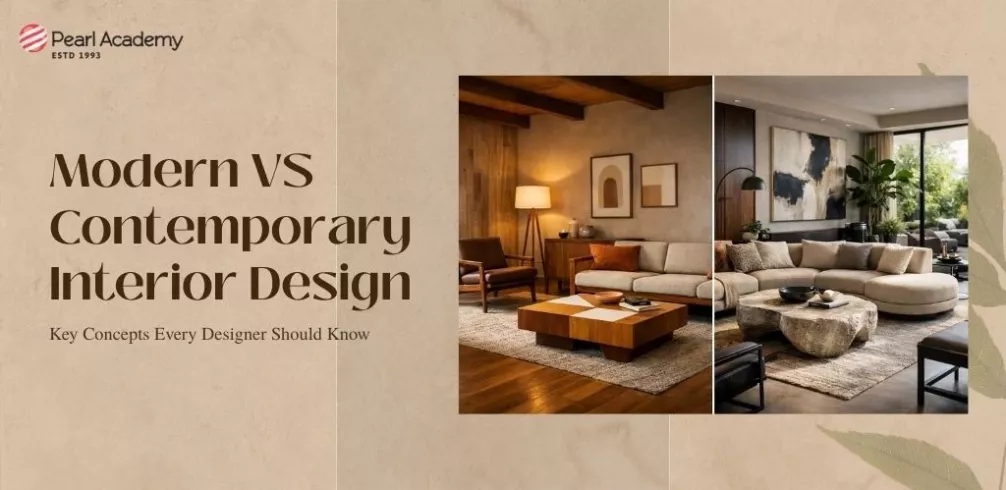
If you've ever found yourself nodding along when someone says 'modern kitchen' and then wondering whether they actually meant 'contemporary', you're not alone. Modern vs contemporary interior design is one of the most commonly confused pairs of terms in the design world, even among seasoned professionals.
Students googling interior design courses, young architects trying to nail a client brief, or parents researching what their child will learn in a design programme, everyone hits this wall at some point. The confusion is understandable: both styles look sleek and uncluttered, both avoid heavy ornamentation, and both appear in glossy design magazines side by side without any clear label.
This blog cuts through that confusion. You'll walk away knowing exactly what differentiates modern and contemporary interior design, how to spot them in the real world, and which design choices belong to each style. Whether you're decorating your first home, building a portfolio, or choosing an interior design degree, understanding these distinctions will immediately sharpen your eye and your vocabulary.
Let's start with the most important question: are 'modern' and 'contemporary' the same thing? Short answer: no. Long answer- read on.
Become future-ready with our Interiors Programs
Know More
Here's the twist that trips everyone up: 'modern' in interior design does not mean 'of today.' It refers to a specific design movement- Modernism, that emerged in the early 20th century and reached its peak from roughly the 1920s through the 1970s.
Modern interior design was a reaction against the overly ornate Victorian and Edwardian styles that preceded it. Designers like Le Corbusier, Mies van der Rohe, and Alvar Aalto championed the idea that form should follow function that a well-designed space should serve its inhabitants efficiently, without decorative excess.
Core Characteristics of Modern Interior Design
- Clean, straight lines and geometric shapes — no curves for their own sake
- Natural materials: wood, leather, stone, and metals like chrome or steel
- Neutral colour palette — whites, beiges, greys, and warm browns, sometimes with bold accent tones
- Open-plan layouts that encourage flow and reduce segmentation
- The 'less is more' philosophy — furniture is functional and purposeful
- Exposed structural elements — think visible wooden beams or bare concrete walls
- A sense of warmth, despite the minimalism, due to natural materials and organic textures
Think of a mid-century modern living room: a low-profile teak sofa, a marble coffee table, a statement Eames chair, warm Edison lighting, and nothing on the walls except for deliberate art. That is modern design done right.
'Contemporary' is a living, breathing, ever-changing style, because by definition, it means 'of the current time.' Contemporary interior design refers to whatever is trending and dominant in the design world right now. It evolves decade by decade, absorbing influences from different movements and adapting to new materials, technologies, and cultural shifts.
If modern design is a fixed point in history, contemporary design is a moving target. What looked contemporary in 2005 (think cool greys, dark woods, polished chrome) looks quite different from what's contemporary today (warmer neutrals, sustainable materials, biophilic elements, curved furniture).
Key Traits of Contemporary Interior Design
- Fluid, curvilinear forms — contemporary design today loves a curved sofa or an arched doorway
- Bold use of black as an accent or even a dominant colour — black-framed windows, black fixtures
- Eclectic material mixing — glass, polished concrete, stone, mixed metals, and sustainable/recycled materials
- Emphasis on sustainability and eco-conscious choices — reclaimed wood, bamboo, low-VOC paints
- Smart home integration — spaces designed around technology
- Open, airy layouts with an emphasis on natural light
- Dramatic statement pieces rather than matching sets
- Global and cultural influences — contemporary design borrows from Japanese minimalism, Scandinavian hygge, Indian craft traditions, and more
One way to spot contemporary design: it looks like it could appear in a design magazine published this year. It feels current, confident, and a little unexpected — not locked into a specific historical aesthetic.
Abstract descriptions only go so far. Here are concrete, real-world examples that illustrate contemporary design across different types of spaces:
The Contemporary Living Room
A large curved sectional sofa in a warm clay or terracotta fabric. A sculptural coffee table in travertine stone. Layered lighting — a statement pendant above, warm floor lamps at the corners. A single piece of large-format art. Houseplants incorporated not just as accessories, but as a design intention (biophilic design). No matching furniture sets — every piece feels individually curated.
The Contemporary Kitchen
Handle-less cabinetry in a warm white or sage green. Mixed countertop materials — perhaps a marble island paired with a stainless-steel prep counter. Matte black tap fittings. An integrated range hood that doubles as a sculptural element. Open shelving displaying a curated selection of ceramics, not a random assortment of cookbooks.
Contemporary Corporate Office Design
Open-plan work areas punctuated by acoustic pods for focused work. Biophilic walls of living plants. Flexible furniture — desks that convert, chairs on wheels, modular partitions. Warm lighting throughout (not the harsh fluorescent lighting of older offices). A mix of collaborative zones and quiet spaces. This is what contemporary workplace design looks like in 2025 — it reflects how people actually work today.
Now that we've defined both styles individually, let's put them head-to-head. The easiest way to understand modern vs contemporary interior design is to compare them across specific elements:
| Element | Modern Interior Design | Contemporary Interior Design |
| Time Period | 1920s–1970s (fixed era) | Ever-evolving; reflects the present moment |
| Lines & Forms | Straight, geometric, angular | Mix of angular and fluid/curvilinear |
| Colour Palette | Neutral: whites, greys, browns, warm tones | Neutrals + bolder accents; black is common |
| Materials | Wood, leather, stone, chrome, steel | Sustainable, recycled, mixed materials |
| Furniture Style | Low-profile, functional, often iconic pieces | Statement pieces; mix of textures and styles |
| Lighting | Pendant lights, warm ambient glow | Dramatic statements + layered lighting |
| Nature in Design | Implied through natural materials | Explicit biophilic design, indoor plants |
| Technology | Not a consideration | Integrated smart home systems |
| Key Words | Function, simplicity, warmth, craft | Current, evolving, eclectic, sustainable |
Before we dive deeper into modern vs contemporary design, it helps to review the types of interior design commonly recognised in the field.
Yes, and many of the best-designed homes are exactly that. 'Contemporary modern' is a real design approach that takes the structural principles and natural warmth of Modernism and layers in current trends and materials. You might see a floor-to-ceiling glass wall (a Modernist staple) paired with a curved, artisanal clay lamp (a contemporary choice). The two aren't mutually exclusive; they can be thoughtfully combined.
Understanding contemporary design products isn't just useful for decorating; it's a professional skill. Interior designers, product designers, and retail buyers all need to understand what products are driving the contemporary aesthetic and why.
1) Furniture
Contemporary furniture today tends towards sculptural forms with a craft sensibility. Look for: bouclé fabric sofas with curved silhouettes, travertine stone coffee tables, rattan and woven accents, and mixed-metal shelving units. Brands like Ferm Living, Menu, and Hem typify this direction internationally; in India, brands like Phantom Hands, Chalk Studio, and Wud Furniture are producing beautiful contemporary pieces rooted in Indian craft traditions.
2) Lighting
Lighting is where contemporary design makes some of its boldest statements. Oversized sculptural pendants in organic shapes (think clusters of glass globes, woven rattan domes, or matte concrete cylinders) are widely popular. Smart lighting systems that let you tune colour temperature throughout the day are increasingly considered a standard contemporary feature, not a luxury add-on.
3) Surface Materials and Finishes
Contemporary interiors are defined by their material honesty: materials that look and feel like what they actually are. Key materials in contemporary design products right now include: warm-toned limewash plaster walls, terrazzo flooring and surfaces, fluted glass cabinetry inserts, polished and honed stone (including Indian Kadappa stone, basalt, and Jodhpur sandstone for locally-rooted designs), and handmade tile with slight variations in texture and colour.
4) Textiles and Soft Furnishings
Textiles are where contemporary design embraces tactility and often, Indian craft. Handwoven rugs, block-printed linen cushions, naturally-dyed throws, these bring warmth and story into a space. The growing global interest in artisanal Indian textiles (Ajrakh, Ikat, Khadi) means that Indian interior designers are in a particularly exciting position: their craft heritage is precisely what the contemporary design world is currently searching for.
Whether you're a student building a concept board, a homeowner renovating, or a professional putting together a client presentation, here are actionable contemporary design ideas that reflect current thinking:
1. Embrace the Warm Neutral Palette
The cool greys and stark whites of a decade ago have given way to warm, earthy neutrals. Think terracotta, warm white, sand, warm greige, mushroom, and ochre. These tones are liveable and timeless without feeling retro.
2. Introduce Curves Intentionally
One of the most defining features of contemporary design right now is the return of curves. You don't need to curve everything — even one curved element (an arched doorway, a rounded coffee table, a semicircular headboard) immediately brings a space into the present.
3. Design for Natural Light
Contemporary interiors celebrate natural light. This means considering window placement, using sheer curtains rather than heavy drapes, and choosing paint and material finishes that reflect and diffuse light beautifully rather than absorbing it.
4. Integrate Biophilic Design
Biophilic design — connecting interiors to nature — is arguably the most important contemporary design idea of this decade. This goes beyond putting a plant in the corner. It means designing with natural light, natural views, natural materials, water features, indoor gardens, and even natural sounds in mind. Research shows biophilic design reduces stress, improves focus, and increases wellbeing — which is why it's being adopted everywhere from hospitals to co-working spaces to premium residences.
5. Tell a Material Story
The best contemporary interiors have a material narrative — a coherent story told through the choices of stone, wood, metal, and fabric. Rather than mixing randomly, choose three to four materials that complement each other and use them consistently across the space. For example: warm oak joinery + warm white limewash plaster + matte brass hardware + handwoven linen upholstery. Every element speaks the same language.
6. Prioritise Spatial Flexibility
Contemporary design reflects how we live now — which means spaces that can adapt. A home office that doubles as a guest room. A dining area that can expand for entertaining. Furniture on castors. Modular shelving. Spatial flexibility is not just a practical concern — it's a contemporary design value.
Understanding the difference between modern and contemporary design is one thing. Applying that understanding to real projects — managing clients, working with contractors, navigating building codes, developing sustainable material specifications, producing construction drawings — is a different skill set entirely. That gap is where a structured design education becomes invaluable.
Pearl Academy: Interior Architecture and Design Programmes
Pearl Academy's B.Des in Interior Architecture and Design is a four-year undergraduate programme designed for students who want to work at the intersection of spatial design, architecture, and material culture. The curriculum covers design history (including Modernism and contemporary movements), spatial planning, building technology, lighting design, sustainable design practices, and client communication — everything you need to take a design concept from idea to built reality.
For those looking to deepen their expertise, Pearl Academy's M.Des in Interior Design offers a postgraduate pathway with opportunities for specialisation, research-led projects, and industry engagement. This programme is well-suited for working professionals looking to move into senior design roles, or those who want to develop a distinctive design practice.
| Programme | Duration | Ideal for | Career Opportunities |
| B.Des Interior Architecture & Design | 4 Years (UG) | Students after Class 12 / Foundation year | Interior Designer, Space Planner, Set Designer, Retail Designer |
| M.Des Interior Design | 2 Years (PG) | Graduates & working professionals | Senior Designer, Design Director, Researcher, Design Entrepreneur |

Student Guidance Center: Our Counselors are Just a Click Away.
Let's recap what we've covered. Modern interior design is a fixed historical movement: clean, functional, and warm, rooted in the early to mid 20th century. Contemporary interior design is fluid and evolving, it absorbs the best ideas of its time and constantly refreshes itself.
In the modern vs contemporary interior design debate, neither is 'better.' They serve different purposes, and many of the world's most beautiful spaces draw on both. What matters is understanding the principles well enough to apply them with intention.
If you're at a point in your life where this topic feels more like a career direction than just curiosity where you're googling 'interior design concepts' because you genuinely want to design spaces for a living, then that instinct is worth following. Confusion is completely normal at the start of any creative journey. What moves you forward is action: reading, experimenting, visiting design exhibitions, and eventually, getting formal training that accelerates everything else.