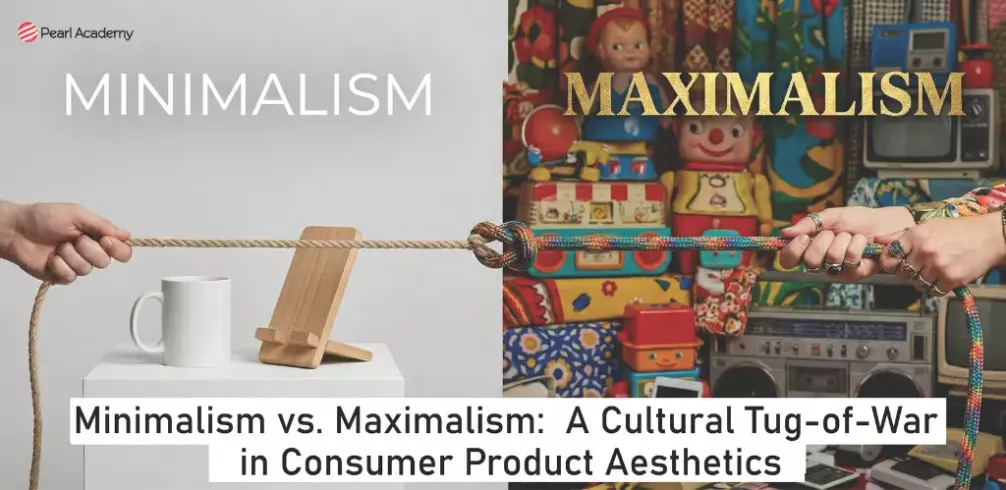
When we talk about consumer culture, two philosophies of consumerism that pops up are Minimalism and Maximalism. While both philosophies are construed to be opposites of each other, where one stands for restraint while the other celebrates abundance, what unites them as philosophies is how they are cultural mirrors, that reflect the broader social values and individual aspirations.
Become future-ready with our Product Design Programs
Know More
Industrial excess, post-war consumerism and the heightened sense of extravagance beget a movement seeped in bare minimum- Minimalism. Its ethos, “less is more,” seeks simplicity, clean lines, and functional elegance (Sudjic 45). Scandinavian furniture, Apple’s sleek product design, and the rising popularity of capsule wardrobes scream minimalist design exemplifying the aesthetic. What makes minimalism an interesting and attractive concept is a person’s psychological desire for order in an overstimulated world, promising calmness, efficiency, and even moral virtue in rejecting waste (Koren 78). But what’s often said in critique of minimalism is it being a performance of privilege, where the rich can afford “less but better.”, questioning the systemic barriers to accessibility shaped by monetary, cultural, and social factors (Yarrow and O’Donnell 132).
Maximalism, in contrast, thrives on bold expression, layered textures, and eclectic abundance. Tracing its genesis to baroque art and Victorian interiors, Maximalism propounds the idea of opulence linked with social status (Mukerji 213). In contemporary times, maximalism re-emerges in fashion’s loud prints, statement sneakers, and interior spaces filled with vibrant colours. It appeals to identities that defy uniformity by valuing uniqueness, cultural fusion, and emotional ebullience. Critics, however, draw attention to the possibility of overindulgence and sensory overload (Campbell 92).
in today’s market scenarios, these philosophies now contend against one another as competing strategies of appeal. Tech companies often lean toward minimalist design—streamlined devices, intuitive interfaces—while fashion and lifestyle brands frequently embrace maximalism to stand out in saturated markets (Norman 115). The two aesthetics even coexist within the same consumer: a minimalist smartphone paired with a maximalist sneaker collection is hardly unusual.
The best way to approach a situation is by striking a balance. Rather than looking at minimalism and maximalism as opposing ideologies and strategies, what’s more productive perspective would be through lens of them being complementary. Minimalism offers clarity, discipline, and restraint, while maximalism provides creativity, joy, and cultural richness. While minimalism is a response to excess, maximalism is to monotony- the overbearing anxieties of modern life (Postrel 63). They do not just reflect opposing consumer choices but also a cultural negotiation between control and freedom, silence and noise, scarcity and abundance.

Student Guidance Center: Our Counselors are Just a Click Away.
The tug-of-war between Minimalism and Maximalism will likely continue, shaped by changes in economy, innovation, and cultural likes and dislikes. What we must not forget is aesthetics fluctuate as per personal and collective consciousness and expression, and it would be wrong to view them as rigid categories. Consumers, consciously or not, navigate this spectrum daily, making a choice between a ‘whisper’ and a ‘scream’ when picking those products off the rack, and inhabiting spaces of their dream.
References
- Campbell, Colin. The Romantic Ethic and the Spirit of Modern Consumerism. Blackwell, 1987.
- Koren, Leonard. Wabi-Sabi for Artists, Designers, Poets & Philosophers. Stone Bridge Press, 1994.
- Mukerji, Chandra. From Graven Images: Patterns of Modern Materialism. Columbia UP, 1983.
- Norman, Donald A. The Design of Everyday Things. Basic Books, 2013.
- Postrel, Virginia. The Substance of Style: How the Rise of Aesthetic Value Is Remaking Commerce, Culture, and Consciousness. HarperCollins, 2003.
- Sudjic, Deyan. The Language of Things: Design, Luxury, Fashion, Art. W. W. Norton & Company, 2009.
- Yarrow, Kit, and Jayne O’Donnell. Gen BuY: How Tweens, Teens, and Twenty-Somethings Are Revolutionizing Retail. Wiley, 2009.