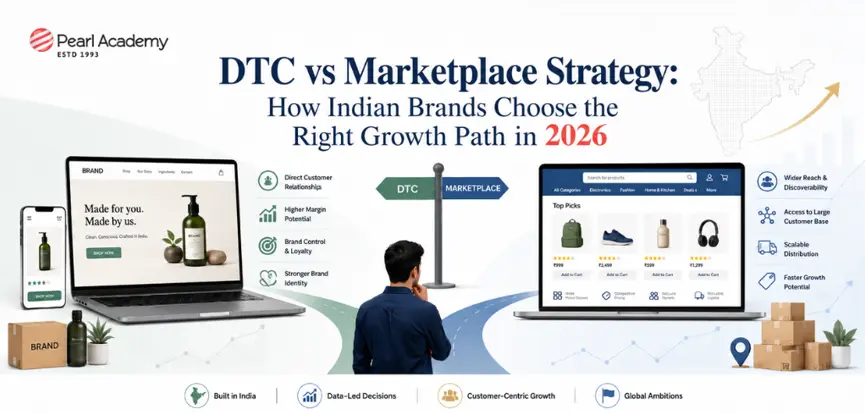
If you have ever launched a product in the Indian market, you know the exhilarating yet exhausting dilemma of where to sell it. Do you open your own digital boutique to have a direct conversation with your fans, or do you set up shop in the bustling digital malls of Amazon, Flipkart, or Nykaa? By 2026, this is no longer a simple choice of "either/or." It has become a sophisticated strategic manoeuvre that determines whether a brand merely survives a season or builds a legacy.
As a researcher of market dynamics, I have watched the Indian Direct-to-Consumer (DTC) landscape evolve from a niche experiment into a high-stakes battle for data and identity. In 2026, the brands winning the race are those that understand the fundamental trade-off between the "Rent" of a marketplace and the "Responsibility" of a standalone site.
Many founders today are no longer asking where they can sell the fastest, but where they can build the strongest long-term customer relationship. At the same time, rising digital advertising costs and shrinking consumer attention spans have made blind expansion an expensive mistake. The smartest Indian brands are therefore treating commerce not just as a sales channel decision, but as a carefully designed ecosystem that balances visibility, loyalty, and profitability.
Become future-ready with our Business Programs
Know More
For most emerging Indian brands, marketplaces are the oxygen of their early existence. These platforms offer an infrastructure that is almost impossible to replicate alone. They provide immediate trust, world-class logistics, and a massive audience that is already in a "buying" state of mind.
Think of a marketplace as a prime spot in a global shopping festival. The visitors are there, the security is handled, and the payments are seamless. However, this convenience comes with a "visibility tax." On a marketplace, you do not own the customer; you are merely renting their attention. If the platform changes its algorithm or promotes a competitor’s private label next to yours, your revenue can vanish overnight.
In contrast, a DTC strategy is about building a "moat" around the customer relationship. When a brand like an artisanal coffee roaster or a sustainable apparel label drives traffic to its own website, it is playing a long game.
The primary asset here is not just the sale, but the data. In 2026, knowing exactly how a customer from Bengaluru differs from one in Chandigarh is the ultimate competitive advantage. This direct link allows for hyper-personalization and, more importantly, higher retention. Without the "noise" of a thousand other search results, the brand has the space to tell its story. The DTC path is about turning a transaction into a relationship.
We are currently seeing a "Hybrid Harmony" emerging among the most successful Indian players. They use marketplaces as an acquisition engine to reach the masses and then use exclusive product launches or loyalty programs to "migrate" those high-value customers to their own DTC platforms.
This is essentially the Migration Model. Marketplaces provide the breadth, while DTC provides the depth.
- Marketplace for Reach: Use the platform's logistics and search volume to test new products and acquire new users.
- DTC for Retention: Offer a premium experience, subscription models, and direct support to keep the most loyal 20 percent of your audience coming back.
- Exclusive Drops on DTC: Many brands are now reserving limited editions, early access launches, or member-only collections for their own websites to create a sense of exclusivity.
- Marketplace as a Discovery Tool: Several emerging labels are treating marketplaces less as profit centres and more as visibility engines that help consumers discover the brand for the first time.
- Data-Led Decision Making: Customer behaviour on DTC platforms is helping brands make sharper decisions on inventory, regional preferences, pricing, and even future product development.

Student Guidance Center: Our Counselors are Just a Click Away.
The growth path for an Indian brand in 2026 is not about choosing a side. It is about choosing a sequence. If you focus only on marketplaces, you are a commodity. If you focus only on DTC too early, you are invisible. The art of modern commerce lies in using the marketplace to find your audience and using your own platform to keep them.
Ultimately, the right growth path is whichever one allows you to tell your story without losing your shirt.
References