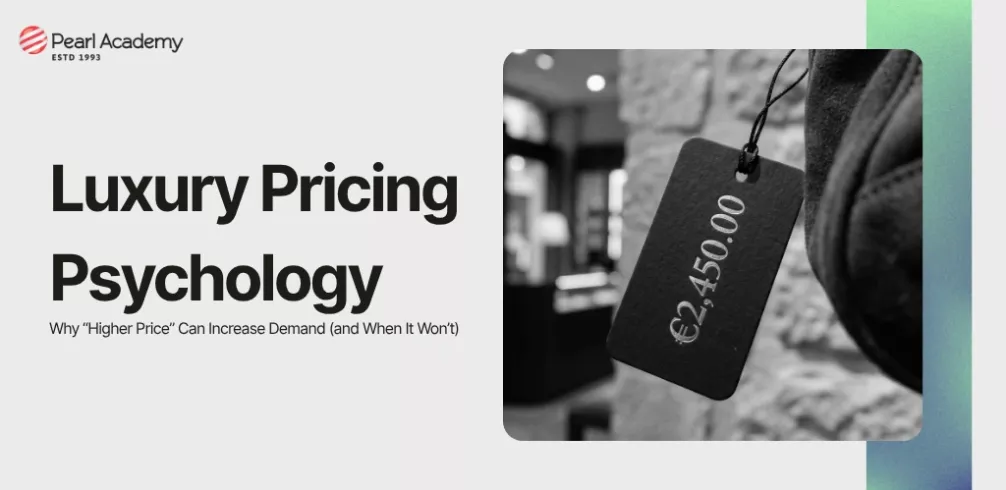
As we navigate the luxury landscape of 2026, a peculiar phenomenon has moved from the fringes of high-end boutiques to the center of global digital commerce. While most of the economy clings to the traditional laws of supply and demand, where a price hike leads to a drop in sales, the upper echelon of the market operates on a different logic.
In most markets, raising prices kills demand. In luxury, it can ignite it. In 2026, this paradox is no longer niche, it is strategy.
In my decades of observing market shifts, I have rarely seen the "Veblen Effect" as potent as it is today. In this world, the higher the price, the higher the desire. But as we move further into a post-materialist era, the psychology behind that price tag is shifting from "What does this cost?" to "What does this cost me to be seen with?"
Become future-ready with our Business Programs
Know More
Luxury pricing in 2026 isn't just about covering the cost of Italian leather or Swiss movements. It functions as a psychological gatekeeper. When a brand like Hermès or a high-end EV manufacturer raises prices, they aren't just adjusting for inflation; they are re-establishing exclusivity.
The psychology at play here is Social Signalling. In an era where "stealth wealth" and "quiet luxury" have become the dominant aesthetics, a high price serves as a silent, high-frequency signal. It ensures that the circle of ownership remains small. For the ultra-high-net-worth individual, the price is the primary feature because it guarantees that the product will not be ubiquitous. If everyone can afford it, it ceases to be a luxury; it becomes a commodity.
From Ownership to Optics - luxury today is less about owning and more about signalling identity.
We also see the Price-Quality Heuristic working overtime. In a world of AI-generated fast fashion and mass-produced replicas, consumers use price as a proxy for authenticity and craftsmanship.
- The Trust Factor: When a consumer sees a price significantly higher than the market average, their brain subconsciously fills in the blanks: It must be sustainably sourced. It must be handmade. It must be rare.
- The Emotional ROI: There is a genuine dopamine hit associated with "the sacrifice." Paying a premium creates an emotional investment in the item that a discount ever could.
Today’s luxury consumer is not price-sensitive, but they are narrative-sensitive.
Even in 2026, a high price is not a magic wand. There is a thin line between "prestigious" and "predatory," and modern consumers are quicker than ever to spot the difference. Increasing prices will fail to drive demand under three specific conditions:
- The Transparency Trap: With blockchain-verified supply chains becoming standard, consumers can now see the "true cost" of goods. If the markup feels like a "brand tax" without a corresponding increase in heritage or innovation, the Veblen effect collapses into resentment.
- Middle-Market Paralysis: Brands attempting to "premiumize" without the pedigree often find themselves in no-man's land. If you don't have the history of a legacy house or the radical innovation of a tech disruptor, a high price just looks like a mistake.
The Sustainability Contradiction: Today’s luxury buyer is hyper-aware of "greenwashing." A high price tag on a product that leaves a heavy carbon footprint is no longer a sign of status; it’s a sign of being out of touch. In emerging markets like India, pricing also reflects aspiration and social mobility.

Student Guidance Center: Our Counselors are Just a Click Away.
For brands and strategists, the lesson of 2026 is clear: Price is a story, not a number. To successfully use high pricing to drive demand, the cost must be tethered to a narrative of scarcity, extreme craftsmanship, or ethical leadership.
The moment a price feels arbitrary, the magic evaporates. But when it feels like an entry fee into a rare world of excellence, the consumer won't just pay it; they will thank you for the opportunity.
Luxury pricing is not about how much something costs. It is about what it costs to belong.
References:
- Kapferer, J. N., & Bastien, V. (2024). The luxury strategy: Break the rules of marketing to build luxury brands (3rd ed.). Kogan Page.
- Veblen, T. (2017). The theory of the leisure class (Classic ed.). Oxford University Press. (Original work published 1899).
- Wiedmann, K. P., & Hennigs, N. (Eds.). (2025).Luxury marketing: A handbook on the psychological and social drivers of prestige consumption. Springer Nature.