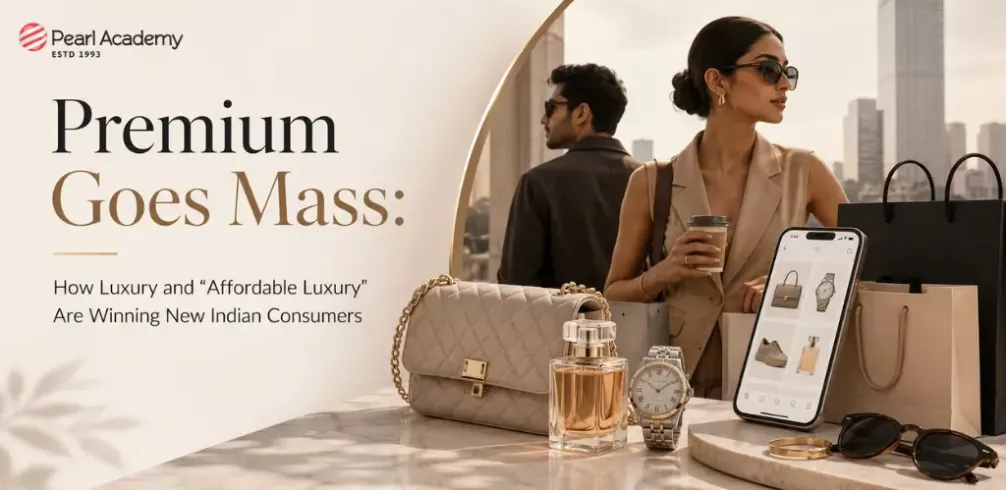
Growing Indian middle class and a strong "premiumization" trend have significantly changed consumer behavior in the Indian market, additionally, rise of social media, internet penetration, and consumer behavior changes among Gen Z and Millennial consumers, have resulted in the rise of affordable luxury. Today customers no longer must spend extravagant amounts on heritage luxury and inexpensive mass-market items. Instead, customers are embracing reasonably priced luxury, a sweet and comfortable spot that provides deep emotional fulfillment, good quality, and brand status.
Become future-ready with our Business Programs
Know More
The target market for inexpensive luxury goods is consumers who desire superior quality and brand prestige but are unwilling to pay the premium prices associated with elite, high-end luxury goods. This category effectively bridges the gap between mass-produced items, which are incredibly accessible and inexpensively priced but of lower quality, and high-end luxury products sold specifically to a particular, affluent demographic.
Although affordable luxury goods are usually more expensive than mass-market items, middle-class and upper-middle-class consumers can nevertheless buy them. Brands market these products to aspirational consumers with disposable wealth so they may make thoughtful lifestyle choices and pay a little bit extra for better design, craftsmanship, and service.
The following are some of the key characteristics of affordable luxury:
1. Better quality and craftmanship: Products marketed as affordable luxury are often crafted with better quality and raw materials, and careful attention to detail. Often these products can rival high-end luxury brands in terms of quality.
2. Accessible pricing: While not cheap, the pricing for affordable luxury items is often accessible to consumers with disposable income. This pricing model allows customers to afford better quality goods at attainable prices and avoid financial strain.
3. Lifestyle and status: These products allow consumers to make lifestyle choices that reflect elegance, taste, and self-assurance without overly displaying wealth.
4. Practical Indulgence: It gives customers a taste of luxury without needless spending by fusing refinement with practicality.
While affordable luxury makes premium brands and products more attainable, it also raises an interesting contradiction. Luxury has traditionally been associated with rarity, exclusivity, and limited access. However, as luxury-inspired products become available to a wider audience, some of that sense of exclusivity can begin to fade. Consumers are often drawn not only to the quality of these products but also to the social meaning attached to them.
As a result, affordable luxury sits in a unique space it offers the experience and symbolism of luxury without the barriers traditionally associated with it. In doing so, it challenges the very idea of luxury itself: if everyone can access it, does it remain truly exclusive? This tension between accessibility and exclusivity is what makes affordable luxury both appealing and complex in today's consumer landscape.
Driven by growing Indian economy and emerging consumerism in India, the Indian middle class and households with disposable income often find themselves in financially viable position to make lifestyle choices where they can opt for quality and niche brand. Indian For example, while stores such as Zudio and Reliance Retail offer mass-produced and financially accessible fashion options, brands such as Zara, H&M India, and FabIndia are preferred by many despite having pricier products, thanks to the quality and brand identification. As per the trends, India is will be the third-largest consumer economy by 2030, with consumer spending which was US$ 2.4 trillion in 2022 is expected to grow to US$ 6 trillion.
The following are contributing factors to this unprecedented growth in affordable luxury:
1. Rising Indian Middle Class
Over time, India's economy has grown dramatically, increasing per capita income and giving the middle class a large amount of discretionary income. Because of these favorable economic statistics, Indian consumers are able to put quality above quantity and make lifestyle decisions that provide a premium experience without demanding elite money.
2. Premiumization
More and more Indian brands are providing high-end goods at reasonable costs. This "premiumization" trend allows consumers to purchase greater quality, authenticity, and brand value across a variety of industries, including watches, restaurants, wellness, beauty and skincare, and home décor.
3. Social Media and Influencer Culture
The reach of high-end companies has been significantly increased by platforms like Instagram, YouTube, and X (previously Twitter). Aspiration is no longer restricted to tier-1 metro areas; tier-2 and tier-3 markets can now afford high-end aesthetics because to internet exposure. Brands are able to tailor their pricing strategies for customers in smaller cities with growing purchasing power because to this extensive digital footprint.
4. Expansion of Digital Stores and E-Commerce
E-commerce has made high-end goods extremely accessible to smaller communities because of strong infrastructural development and widespread internet penetration. Additionally, by avoiding the high overhead expenses associated with physical retail, digital-first stores enable direct-to-consumer (D2C) models that provide highly customized customer experiences.
5. Increasing Gen Z and Millennial Consumers
Gen Z and Millennial consumers see spending as a means of self-expression, individuality, and personal branding, in contrast to earlier generations that placed a high value on saving and stringent asset ownership. For fashion, cosmetics, lifestyle items, and unique experiences, these groups are clearly prepared to pay more.
6. Growth ‘Masstige’ Consumption
The rise of "Masstige" (a portmanteau of mass and prestige) has fundamentally shifted consumer habits. Masstige products offer premium materials, superior craftsmanship, and an elevated brand experience at a fraction of true luxury prices, allowing consumers to trade up without financial strain.
7. Status Signaling and Aspirational Consumption
Ownership of a product has traditionally been associated with social standing. Affordable luxury functions as a tool for aspirational purchasing in this setting, enabling people to express taste, quality, and upward social mobility without having to pay the exorbitant price of heritage luxury homes.
8. Demand for Experiences Over Possessions
Shifting economic realities have led consumers to invest more heavily in experiences rather than mere physical possessions. This indulgence-driven spending allows brands to position affordable luxury items not just as products, but as lifestyle upgrades that satisfy the growing emotional demand for everyday luxury.
Both customers and brands benefit from affordable luxury. It enables companies to reach a wider audience while providing customers with high-end experiences without the exorbitant expenditures associated with traditional luxury.
Benefits of Affordable Luxury for Brands
1. Access to a larger consumer base: Affordable luxury enables brands to attract aspirational middle-class consumers, significantly expanding their customer base.
2. Higher profit margins: Premium products often command higher prices than mass-market offerings due to their perceived value, design, quality, and brand image, resulting in better margins for businesses.
3. Stronger brand equity: Affordable luxury helps brands position themselves as aspirational and desirable.
4. Increased customer loyalty: Consumers who have positive experiences with entry-level premium products are more likely to remain loyal.
Benefits of Affordable Luxury for Consumers
1. Access to premium experiences: Consumers can enjoy better design, quality, service, and brand prestige without paying traditional luxury prices.
2. Enhanced self-expression: Affordable luxury products help consumers reflect their personality, lifestyle, and aspirations through fashion, beauty, accessories, and lifestyle choices.
3. Better value for money: Many affordable luxury brands offer superior craftsmanship, materials, and durability compared to mass-market alternatives, making them worthwhile investments.
4. Greater confidence and social recognition: Premium products often provide emotional satisfaction and social value, helping consumers feel confident and connected to desired lifestyles and communities.
Affordable luxury in 2026 is more than simply a product category for fashion manufacturers; it has developed into a significant marketing tactic that shapes consumer behavior and appeals to the younger consumer base. The global market for reasonably priced luxury goods is predicted to increase from USD 131.17 billion in 2026 to USD 174.99 billion by 2034, according to a Fortune Business Insights analysis. According to the survey, the rise of reasonably priced luxury goods can be attributed to rising middle-class prosperity, digitalization, and changing tastes among millennials and Generation Z, who respect both style and brand legacy.
The most popular brands in 2026 are those that provide customers a sense of luxury rather than being the most exclusive. One of the most significant marketing strategies influencing India's fashion, retail, beauty, and lifestyle sectors is affordable luxury, which has become a strategic instrument that combines desire, accessibility, experience, and identity.
As affordable luxury continues to gain momentum, an important question remains: does affordable luxury truly exist, or is it primarily a marketing construct designed to make consumers feel closer to luxury?
The answer perhaps lies somewhere in between. On one hand, many affordable luxury brands genuinely offer superior quality, thoughtful design, better materials, and elevated customer experiences compared to mass-market alternatives. A consumer purchasing a handbag from Michael Kors instead of a generic retailer, or choosing a premium skincare brand such as Forest Essentials over conventional products, is often paying for tangible improvements in craftsmanship, ingredients, and brand experience.
On the other hand, affordable luxury also thrives on perception. Brands carefully curate narratives around exclusivity, aspiration, and lifestyle, allowing consumers to access the feeling of luxury without entering the world of ultra-high-end brands such as Louis Vuitton, Hermès, or Rolex. In this sense, consumers are not just purchasing products—they are buying into stories, identities, and aspirations.

Student Guidance Center: Our Counselors are Just a Click Away.
This creates an inherent contradiction. Luxury has traditionally been defined by scarcity and exclusivity, yet affordable luxury depends on scale and accessibility. The more consumers who can participate in luxury, the more brands must redefine what luxury means. As a result, affordable luxury may be less about owning something rare and more about accessing a premium experience that feels personal, meaningful, and aspirational.
Perhaps the real success of affordable luxury is not that it makes luxury affordable, but that it redefines luxury itself. In today's market, luxury is increasingly measured not by price alone, but by how a product makes consumers feel—confident, accomplished, and connected to a desired lifestyle. Whether viewed as a genuine category or a sophisticated marketing strategy, affordable luxury has undeniably reshaped the relationship between aspiration, consumption, and status
References:
1. India Brand Equity Foundation. (n.d.). India’s consumer market to become world’s second largest by 2030: Report. https://www.ibef.org/news/india-s-consumer-market-to-become-world-s-second-largest-by-2030-report
2. India Brand Equity Foundation. (n.d.). Affordable luxury: Understanding premiumisation and evolving consumer preferences. https://www.ibef.org/research/case-study/affordable-luxury-understanding-premiumisation-and-evolving-consumer-preferences
3. Fortune Business Insights. (n.d.). Affordable luxury fashion market (Report No. 114176). https://www.fortunebusinessinsights.com/affordable-luxury-fashion-market-114176